


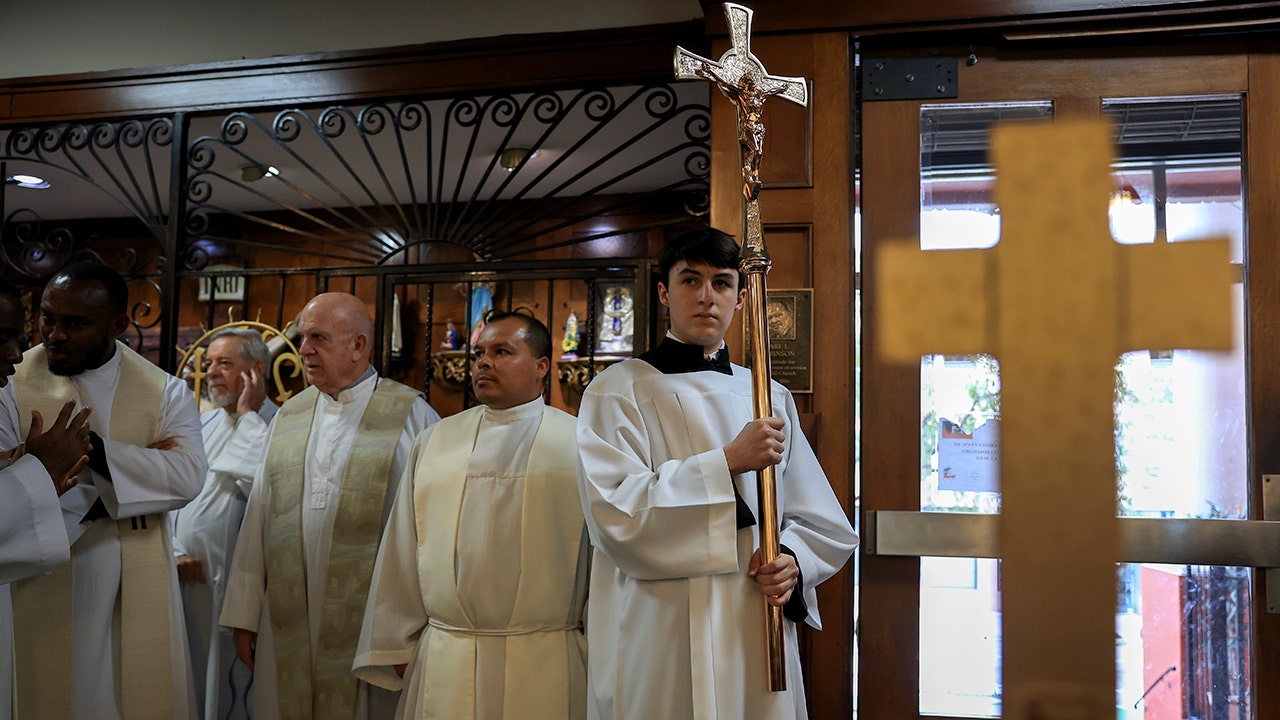
On paper, Catholicism looks like it’s having a moment.
The global Catholic population has surpassed 1.4 billion. Eucharistic processions are drawing record crowds. And last summer, more than 50,000 people packed into Indianapolis for the National Eucharistic Congress — the first of its kind in 83 years.
But on the ground, the picture looks very different.
Across the United States, dioceses are merging parishes, closing churches and asking fewer priests to cover more communities.
CATHOLIC CONFERENCE SHATTERS ATTENDANCE RECORDS AS 26,000 YOUNG PEOPLE FLOCK TO FAITH EVENT
Even as interest — especially among younger adults — begins to rebound, the Church keeps running into the same hard limit:
It needs priests. And there aren’t enough of them.
When asked about the priest shortage, Dan Monastra, a seminarian for the Archdiocese of Philadelphia, said, “One reason is the overall lack of desire in our culture to commit oneself to something permanent, especially among younger generations. We see this not only with the priesthood but with marriage as well. Another reason is that the priesthood is antithetical to what modern culture offers; namely, comfort.”
This is the paradox of the present moment: a renewed interest in Catholicism colliding with a severe priest shortage and the business of staffing, financing, and sustaining parish life. The Catholic population is growing with fewer priests to guide it.
The numbers
The priest shortage isn’t just a perception — it shows up clearly in the data.
According to the Church’s statistical yearbook, the number of priests worldwide fell to 406,996 in 2023 — down from the year before and continuing a multiyear decline.
The pipeline is shrinking, too.
Globally, the number of seminarians dropped from 108,481 in 2022 to 106,495 in 2023 — part of a steady slide that’s now lasted more than a decade.
That creates a long-term problem: fewer priests today means even fewer tomorrow.
“With fewer priests to staff parishes, many dioceses across our country have engaged in restructuring or consolidating of parishes to deal with this reality,” Rev. John Donia, pastor at St. Elizabeth Parish in Chester Springs, Pennsylvania, told Fox News Digital.
The result is a growing gap between demand and supply.
Older priests are retiring or dying, often in clusters. At the same time, the need for Mass, confession, hospital visits and pastoral care isn’t going away.
CATHOLIC CONVERSIONS RISE AS YOUNG ADULTS ‘HUNGRY FOR TRUTH’ TURN TO FAITH AND REJECT SECULARISM, BISHOP SAYS
In the United States, that gap is especially visible.
The Church still operates with a footprint built for a different era — one with far more priests. Now, many dioceses are being forced to rethink everything from parish boundaries to staffing models.
And it’s happening nationwide.
“We are entering into a different time with new challenges. The world is constantly changing, and it is up to the Church to find ways to bear witness to Christ in the midst of these changes while still upholding the ancient faith,” Monastra said, when asked why parishes are still closing even when interest in Catholicism is rising.
“This has been true throughout history, and it remains true today. My hope is that, rather than looking at parish closures in a negative light, we see them for what they really are: occasions to find new ways to bring Christ to others.”
Even where younger adults are more visible, the math still bites. A parish can be reviving spiritually while still being financially fragile or difficult to staff.
The business of priesthood: Formation pipelines, staffing models, and costs
The Catholic priesthood in the United States is at a critical juncture.
Formation is expensive. The Center for Applied Research in the Apostolate (CARA) reported 2,920 seminarians in post-baccalaureate formation (pre-theology and theology) in 2023–2024.
The direct educational costs are significant. CARA reports the average annual tuition of about $24,763 and room and board of about $15,254 for seminarians in theology programs.
Those numbers don’t include the broader costs of things like counseling, healthcare, and operational overhead.
As a result, dioceses are making tough investment decisions: fewer dollars, fewer candidates, and higher expectations for formation quality.
MARK WAHLBERG PARTNERS WITH HALLOW PRAYER APP FOR ‘PRAY 40’ LENT CHALLENGE INITIATIVE TO ENCOURAGE FAITH
But why are there fewer candidates if religion is seeing a resurgence?
Rev. Donia noted some contributing factors in his interview.
“There are a number of factors to consider: fewer large families with a natural pipeline to the priesthood… Clergy abuse scandals… Priesthood is counter cultural, especially in our instant-gratification culture,” he explained.
As a result, the pipeline increasingly relies on international vocations.
CARA reported that 17% of graduate-level seminarians were born outside the U.S. in 2024-2025.
‘ROSARY’ BEATS ROGAN: IS FAITH-BASED MEDIA BECOMING MAINSTREAM?
But relying on international priests comes with risks — visa issues, cultural challenges, and shifting global needs as many “sending” countries face their own growth and pastoral demands — forcing staffing to be redesigned in real time.
As priests cover more parishes, dioceses are expanding the roles of deacons and lay leaders for administration, catechesis, and pastoral work while also confronting a hard limit: only priests can celebrate Mass and absolve sins in confession.
This isn’t just a staffing problem.
It’s a sacramental one.
When one priest covers multiple communities, it means fewer Masses, fewer confessions, less time for hospital visits — and less presence overall.
Why are parishes still closing even when interest is rising?
If more young people are showing up, why are churches still shutting down?
Because parish closures aren’t about one good Sunday.
They’re about whether a parish can survive long-term.
Several pressures are hitting at once:
- Buildings: Aging churches, rising insurance costs and deferred maintenance can overwhelm even active parishes.
- Geography: Catholics are moving — growing in the South and West, shrinking in some older urban areas — leaving behind infrastructure that no longer fits where people live.
- Clergy: Fewer priests means fewer pastors, which forces mergers even when individual communities are still vibrant.
- Finances: Donations tend to follow consistent attendance. A growing young-adult group often isn’t enough to offset decades of decline and fixed costs.
Put it together, and you get a paradox:
More spiritual energy — but less physical infrastructure.
Parishes can feel alive on Sunday and still be unsustainable on paper.
The revival
As the Church confronts these challenges, there is a noticeable rise in renewed Catholic energy, especially among committed younger adults.
There is a return to the core practices of Eucharistic adoration, confession, a disciplined spiritual life, and a desire for reverent liturgy.
The U.S. bishops emphasized Eucharistic renewal through the National Eucharistic Revival (2022–2025), culminating in the 2024 Congress. Their conclusion? If Catholicism is going to regenerate, it will do so because of what makes it distinct — especially faith in the Real Presence of Jesus Christ in the Eucharist.
And there is a proposed connection to vocations: a culture that treats the Eucharist as central — rather than symbolic — is more likely to foster priestly vocations.
“Traditional expressions, including reverent liturgy and clear teaching, resonate strongly with younger Catholics,” Rev. Donia told Fox News Digital.
What’s driving spirituality in Gen Z and millennials?
Here’s the key shift: younger generations are less tied to institutions — but still searching for meaning.
Springtide Research, surveying ages 13–25, consistently finds that the dominant story (“young people don’t care about faith”) is incomplete; many still say they believe — even if they don’t attend regularly.
EXCLUSIVE: CARLO ACUTIS’ MOTHER ON HIS CANNONIZATION AND HOW THE FIRST MILLENNIAL SAINT CHANGED HER LIFE
Pew Research Center shows a similar trend: younger adults are less likely to identify as Christian than older cohorts, and religious switching is common — yet many still express some form of spiritual belief.
Pope Leo XIV has repeatedly acknowledged what he describes as a “crisis” in priestly vocations, warning of strain within the priesthood while urging young people to consider religious life.
Monastra, a Gen Z seminarian, said his call to the priesthood was driven by a desire for something “real and authentic.”
“I have found that ‘something,’ because there is nothing more true, more good, and more beautiful than Christ Jesus,” he said. “I have experienced great love from Him, and my desire to one day become a priest is simply a response to that love.”
There are several factors driving the recent resurgence in spirituality, including:
1) A mental health and meaning crisis:
Anxiety, loneliness, and “purpose fatigue” are widely reported across Gen Z. Barna’s Gen Z research emphasizes needs around meaningful relationships, hope, healthy digital habits and purpose — all of which faith communities can address when they’re strong and credible.
In that environment, religion can reemerge as an answer to a basic question: What am I for? Catholicism, when presented in a serious and coherent way, offers identity, moral formation, community, and a transcendent framework.
2) Distrust of institutions and hunger for authenticity:
Gen Z and millennials are often skeptical of institutions. The Church has been affected by scandal and declining trust in some regions.
Yet that same skepticism can create openness to more intentional forms of faith. When young adults return, they often seek coherent teaching, serious spiritual practices, and authentic community.
3) Community as an antidote to fragmentation:
Younger adults live in an era of high connectivity and low belonging. A parish that offers genuine friendship, intergenerational support, and a shared mission can feel like a lifeline.
4) A search for embodied practice, not just opinions:
Many young adults are tired of spirituality that stays in the head. Catholicism is a whole-body faith: kneeling, fasting, feasting, pilgrimage, sacramental signs, daily prayer, moral discipline. For people shaped by screen life, embodied practices can be a form of recovery.
5) Social media makes subcultures possible, including Catholic ones:
Online life has clear downsides, but it also allows dispersed communities to connect and enables priests and creators to share teaching widely. This can accelerate “micro-revivals,” even if it does not immediately show up in national data.
MOST POPULAR PRIEST ON SOCIAL MEDIA REACTS TO VIRAL TIKTOKS ABOUT GOD, INTERPRETATIONS OF THE BIBLE
Rev. Donia pointed to Bishop Robert Barron, founder of Word on Fire, to summarize the contrasting effects of social media on today’s youth.
“Bishop Robert Barron noted that social media offer a ‘golden age’ for evangelization and apologetics,” Donia said. “Yet it exacerbates divisiveness and can turn committed Catholics against each other in ways that scandalize outsiders.”
Though he said social media “accelerates discovery and devotion for many,” he argued the overall effect depends on how “intentionally” people use it.
The collision ahead: Renewal requires priests, and priests require renewal
Without priests, the sacraments become harder to access — and renewal becomes harder to sustain.
Without renewal, fewer men may answer the call to the priesthood.
The practical side can’t be ignored. Seminaries must be funded, formation must be excellent, and dioceses must redesign staffing without hollowing out parish life.
WHAT’S THE WEIRDEST THING THAT EVER HAPPENED THAT MADE YOU THINK GOD WAS REAL?
At the same time, the spiritual side cannot be reduced to strategy. Even the most effective vocation plan will fall short if Catholics do not recover a lived sense that the Eucharist is central.
Rev. Donia called that insight “profoundly true” and urged Catholics to take it seriously.
“It’s one of the most important insights into the current state of Catholic life, especially regarding vocations,” he said.
And that is what many younger Catholics appear to be signaling — sometimes quietly, sometimes visibly, as in Indianapolis in 2024 — a willingness to return not to a purely cultural Catholicism, but to a more demanding, sacramental, and Christ-centered faith.
The Church’s challenge is whether it can meet that desire with enough priests, sufficient formation, and the institutional capacity to rebuild — not just buildings, but belief.
Read the full article here