



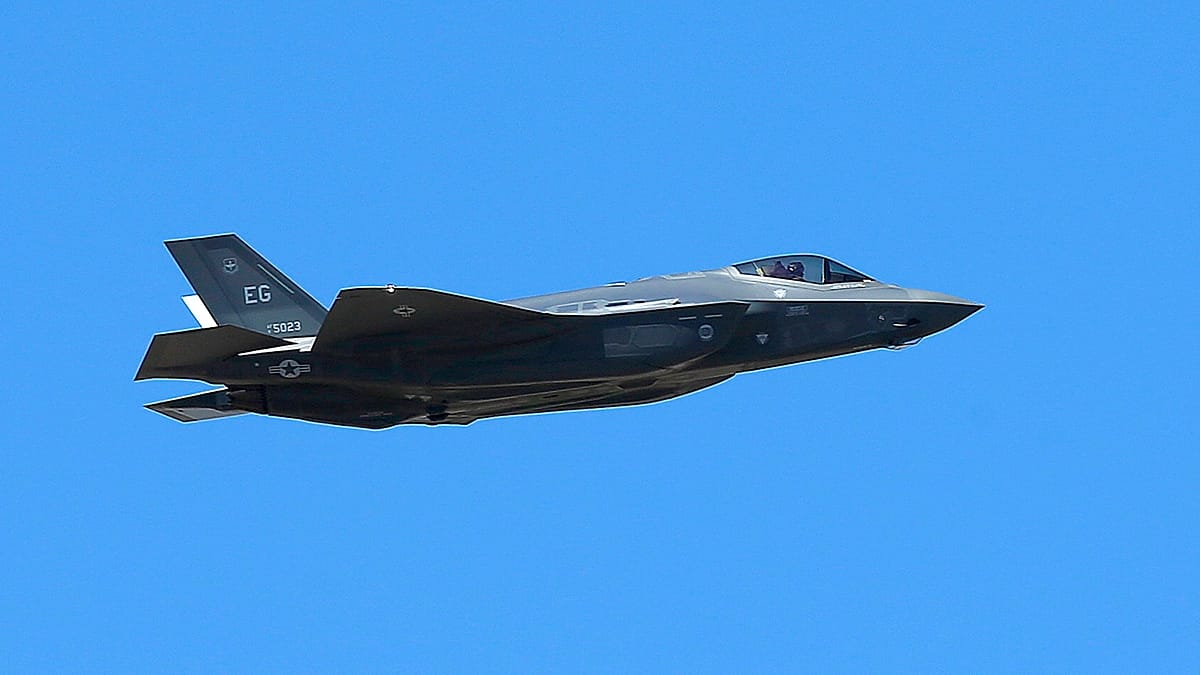
The prospect of Turkey returning to the F-35 fighter jet programme has opened a new front in Washington, with the Greek-American lobby and members of Congress seeking to preserve the existing legal obstacles to the sale of US fighters to Ankara.
ADVERTISEMENT

ADVERTISEMENT
The issue returned to the fore after US President Donald Trump’s meeting with Turkish President Recep Tayyip Erdogan, but so far there has been no official decision by the US administration on Turkey’s re-entry into the programme.
Athens acknowledges that decisions on armaments are a sovereign right of every country and that it has no power of veto over US decisions. However, it believes it has both the right and the obligation to raise with its allies the security issues it considers critical for the stability of the region.
Officials in Athens stress that Turkey remains a NATO ally, yet there are still open issues in Greek-Turkish relations, such as the continued existence of the justification for war adopted by the Turkish Grand National Assembly in 1995, the challenges to Greek sovereign rights and the disputes in the Aegean and the Eastern Mediterranean.
For this reason, Greece is calling for any decisions on the sale of advanced weapons systems to be accompanied by clear safeguards and assurances that they cannot be used against another member state of the Alliance.
The debate, however, has already shifted to Congress, where supporters of maintaining the restrictions recall that Turkey’s removal from the F-35 programme in 2019 was not only a political decision, but was directly linked to the acquisition of the Russian S-400 system.
Dina Titus’s letter and moves in Congress
The first public move against a possible policy change came from Democratic Congresswoman Dina Titus of Nevada, who gathered the signatures of 18 members on a letter to the leadership of the House of Representatives.
The lawmakers are calling for guarantees that current US law will be upheld and that Congress will be ready to intervene if the administration attempts to move ahead with Turkey’s return to the programme.
As Thanos Davelis, Director of Public Affairs at the Hellenic American Leadership Council (HALC), explains, this letter constitutes the first organised reaction in Congress.
“Dina Titus has brought together various, mainly Democratic, representatives – 18 in total – who have sent a letter to the House leadership so that they are ready to act and prevent any move we may see from President Trump on the F-35s,” he noted.
However, Davelis points out that the situation among Republicans is different. While many also appear cautious about a possible sale, they prefer a more discreet approach.
“The Republicans seem to be moving internally. They do not want to put their names to this letter and are trying to persuade the Trump administration from within, making use of their various contacts,” Mr Davelis says.
The legal “wall” against the sale
The main argument of those opposing Turkey’s return to the F-35 programme is that there are specific legislative restrictions imposed by Congress itself.
Turkey’s purchase of the S-400s from Russia led to the implementation of the CAATSA law in the US, which imposes sanctions on major purchasers of Russian defence equipment. At the same time, through US defence budgets, special provisions were introduced that linked Turkey’s return to the F-35 programme to the removal of the S-400s.
“The issue began in President Trump’s first term. The House and the Senate had passed the CAATSA law, which was not only about Turkey, but was a means for the US government to impose sanctions on countries that buy defence systems from states such as Russia,” Davelis explains.
He adds that, after Ankara’s decision on the S-400s, US Congress proceeded with further legislative measures:
“There are two pieces of legislation which essentially stipulate that the F-35s cannot go to Turkey as long as it still possesses the S-400s.”
The crucial interpretation of the word “possession”
One of the key issues under examination in Washington concerns the interpretation of the word “possession”.
US law not only refers to the use or activation of the S-400s, but as to whether Turkey continues to have the Russian system in its possession.
This is why one of the scenarios under discussion is the removal of the S-400s from Turkish control or their transfer to a third country, so that it can be argued that this particular legal obstacle no longer exists.
Beyond the legal dimension, the main concern on the US side has to do with protecting F-35 technology.
Washington fears that the operation of a Russian S-400 system in the same environment as the US fifth-generation fighter could allow the collection of critical data on the aircraft’s stealth characteristics, electronic systems and operational capabilities.
“There is a risk that the S-400s could record or obtain various pieces of information which constitute US secrets about these F-35s, and that this information could then be passed on to the Russians,” Davelis stresses.
This was also the main reason why Turkey was removed from the programme in 2019, despite having taken part in it since 2007 as a co-producing country.
The next moves of the Greek-American lobby
The lobbying effort is not limited to Greek-Americans. According to Davelis, other organisations in Washington are also involved, including bodies representing the American-Jewish community.
“American Jews continue to be a strong political voice. They are well organised and are acting along similar lines in Washington on the F-35 issue,” he says.
At the same time, HALC is continuing its contacts with members of Congress, government officials and think tanks.
The final outcome of the case will depend on the balance between the White House’s desire for a renewed rapprochement with Ankara and Congress’s stance, which has already enacted a strict legislative framework governing the possession of the S-400s.
Davelis estimates, “if Congress mobilises sufficiently, we may see some results.”
Read the full article here