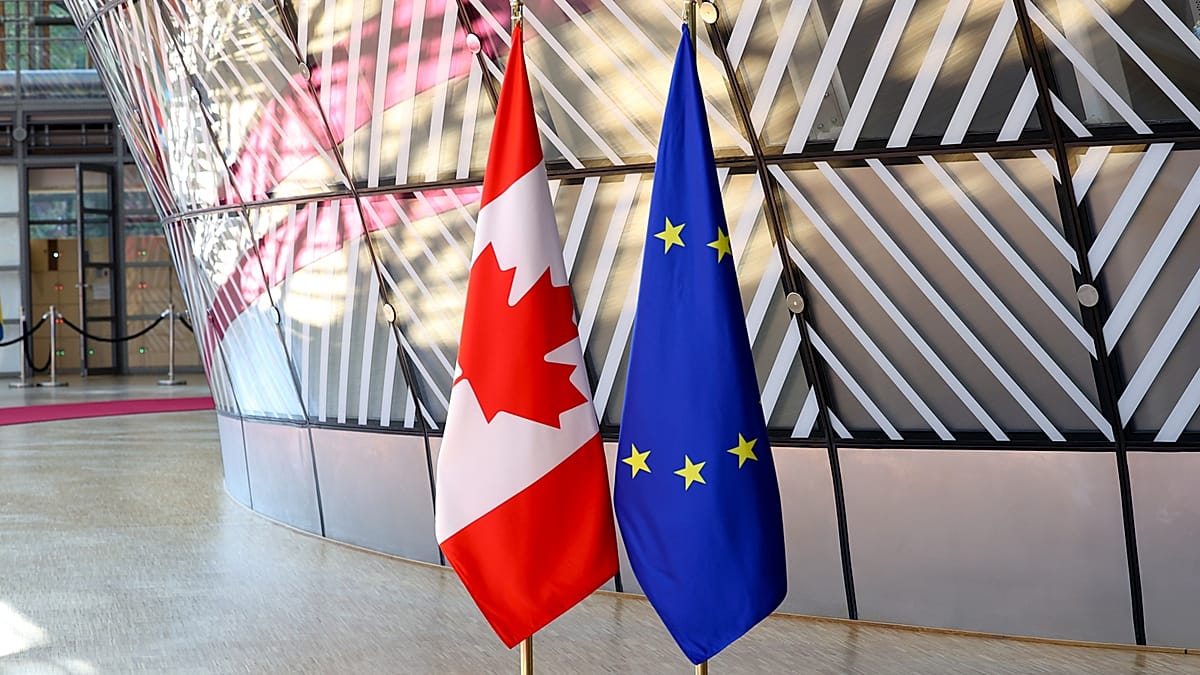




It’s the head-turning, eye-popping announcement of the week: Ursula von der Leyen has invited Canada to make history by becoming the first-ever “associate member” of the European Union.
ADVERTISEMENT

ADVERTISEMENT
“We want to bring the relationship with Canada to the highest level possible,” the European Commission president said in her State of the Union speech.
The following day, speaking from the same lectern in Strasbourg, Canadian Prime Minister Mark Carney said his country “welcomes” the offer and hailed the dawn of an “alliance for the future”.
“Europe and Canada are stronger together,” he said.
The back-to-back speeches made international headlines, caused a political furore, inspired countless memes and even caught Donald Trump’s attention. But they also left many burning questions unanswered.
Here’s what we know – and still don’t know – about the splashy idea.
There’s just no precedent
The concept of “associate membership” is not envisioned in the EU treaties as such. And since it does not exist on paper, there is no precise playbook that Brussels can follow to make it reality.
A similar dilemma emerged earlier this year when German Chancellor Friedrich Merz proposed making Ukraine an “associate member” of the bloc. This, he said, should grant observer status in the decision-making bodies, gradual access to some EU programmes and mutual assistance in the event of a future attack.
Merz’s surprise pitch received mixed reviews from capitals and was rebuffed by Kyiv, which worried the half-in, half-out rank would plunge it into accession limbo.
Commission officials say von der Leyen’s vision fundamentally differs from Merz’s because it is designed for countries outside Europe’s geographic sphere that wish to be politically and economically closer to the bloc.
Brussels is confident the ground-breaking concept can be designed from scratch without the need to revise the EU treaties, a perilous avenue.
Some have suggested that a possible way forward lies with Article 217 of the EU treaties, which holds that “The Union may conclude with one or more third countries or international organisations agreements establishing an association involving reciprocal rights and obligations, common action and special procedure.”
Carney, meanwhile, said the set-up should be “open enough that others can join”.
It’s not enlargement
One thing Carney made sure to stress is that his country would not pursue the conventional full-time membership that Ukraine, Moldova and other candidates are seeking.
According to the treaties, this process is available to “any European State”, which means a nation on the other side of the Atlantic would not qualify.
“Canada is not in a position nor seeking to become a full member of the European Union. Therefore, it’s a different framework,” Carney said after his speech. “It’s a framework that is relevant for a country that shares deep bonds with Europe.”
Accession is a notoriously cumbersome process that requires candidates to adopt thousands of EU laws and align themselves with the bloc’s world-class standards. Each step is subject to unanimity, creating multiple opportunities for vetoes.
Ottawa and Brussels want an arrangement that can be concluded much faster.
But it seems curiosity has been piqued: ahead of Carney’s trip to Strasbourg, a poll showed that a whopping 49% of Canadians supported full-fledged EU membership.
The name is TBD
Though the headlines that emerged from Strasbourg all honed in on the striking “associate member” title, Carney did not outright endorse it. Instead, he stuck to his “alliance for the future” moniker, which is less politically charged.
“President von der Leyen used both terms: alliance for the future and associate membership. The nomenclature, the precise nomenclature, is a question for Europe,” he said. “What matters is the substance.”
For the Canadian premier, “associate membership” carries the connotation of ceding sovereignty to Brussels, something he vowed would not be the case under any circumstance.
“We are looking for partnerships that are complementary, that reinforce our sovereignty, and that’s what is on offer here,” he said. “Canadians are united that nobody is going to tell us what language we speak. No one is going to dictate our culture or with whom we can strike international agreements.”
EU officials have brushed off the semantic clash. For them, the “alliance for the future” is the immediate deliverable and “associate membership” the long-term prospect.
It’ll be put to a vote
After von der Leyen extended her invitation, the conservative opposition in Canada criticised Carney for seeking deeper ties with the EU without an electoral mandate.
In response, Carney cautioned the negotiations were still in early stages and committed to bringing the outcome to a final vote in the Canadian parliament.
“We will have a series of debates, I’m sure, in parliament (and) relevant committees. And ultimately, there will be a vote in the Canadian parliament for the final structure of the alliance that we’re working on,” he said. “It will all roll out transparently.”
On the European side, it remains to be seen how von der Leyen’s team will advance the novel concept through the legislative cycle. The executive has not yet said which department will supervise the work, though the Secretariat-General and DG Trade appear the likeliest candidates to take the reins.
“We’re talking about a very ambitious project here, so this is going to require many services across the Commission. It’s going to be a whole-of-government approach if you want to call it that,” Olof Gill, the Commission’s deputy chief spokesperson, said.
Gill insisted the talks would be carried out in close coordination with the member states, some of which were given a heads-up right before von der Leyen’s speech.
“Big changes in the European Union only happen with the say-so of our member states, and that will always be the case,” he said.
Ireland, Spain and France are among those who have expressed support for exploring the original idea. A high-level discussion on the matter is not excluded when EU leaders gather in October for a busy two-day summit in Brussels.
Later that month, von der Leyen and Carney will meet in Montreal, Quebec. This will be a chance for both to flesh out what exactly they have in mind.
Economy comes first
Still, Strasbourg already gave us a pretty good idea of the areas that von der Leyen and Carney have set their sights on.
Chief among them is commerce, building on the EU-Canada free trade deal, CETA, which still has to be ratified by 10 member states.
Von der Leyen said the goal should be to establish a “common prosperity and economic security space” encompassing intelligent manufacturing, energy, batteries, artificial intelligence, quantum, cyber, defence industry and the Arctic.
Carney echoed these areas and added broadband connections, semiconductors, liquefied natural gas and hydrogen to the list.
He also made sure to underscore Canada’s position as a supplier of critical minerals, which Europe desperately wants to diversify to cut off Beijing’s chokepoints.
“Canada has deposits of over 34 critical minerals, and we are among the top producers of the 10 most essential for the world’s energy transition,” he said.
“Our alliance can help fill Europe’s need for reliable supply, Canada’s need for advanced processing capabilities and our common objective to build complete value chains.”
Another way to deepen ties is for Canada to participate in EU programmes. Canada is already part of the Horizon research platform and the SAFE defence initiative and wants to join the popular Erasmus+ for students and the €90 billion loan for Ukraine.
The four freedoms
Von der Leyen’s invitation has raised the question of whether Canada, a country more than 6,000 kilometres away from continental Europe, will one day benefit from the bloc’s four freedoms of movement: goods, services, capital and people.
The four freedoms are what make the single market seamless, borderless and effectively invisible. Norway, Iceland, Liechtenstein and Switzerland are the only nations outside the EU that enjoy this unfettered access. In return, they have been asked to apply thousands of EU laws without having a direct say in their approval.
Will Canada go as far?
In his speech, Carney said the burgeoning alliance should aim to enable free movement for young people between the EU and Canada.
“We should deepen our people-to-people ties, allowing our youth to live, work and study where they want on either side of the Atlantic,” he said.
Carney also spoke of an “integrated market for financial services to broaden choice and reduce costs for our citizens, improve access to capital for our companies while maintaining our world-leading financial resilience”.
Von der Leyen, however, did not mention any of the four freedoms.
The Commission has consistently said the four freedoms cannot be “cherry-picked”. Earlier this year, Brussels reportedly rejected a post-Brexit overture from London to secure free movement of goods but not people.
Asked if any of them would be available under the “associate membership”, Gill, the spokesperson, neither confirmed nor denied.
“Let’s see where these discussions go,” he said. “Right now, we have a shared commitment between the European Union and Canada that we want to strengthen our relations for mutual benefit, in our own interests.”
Read the full article here