

Published on
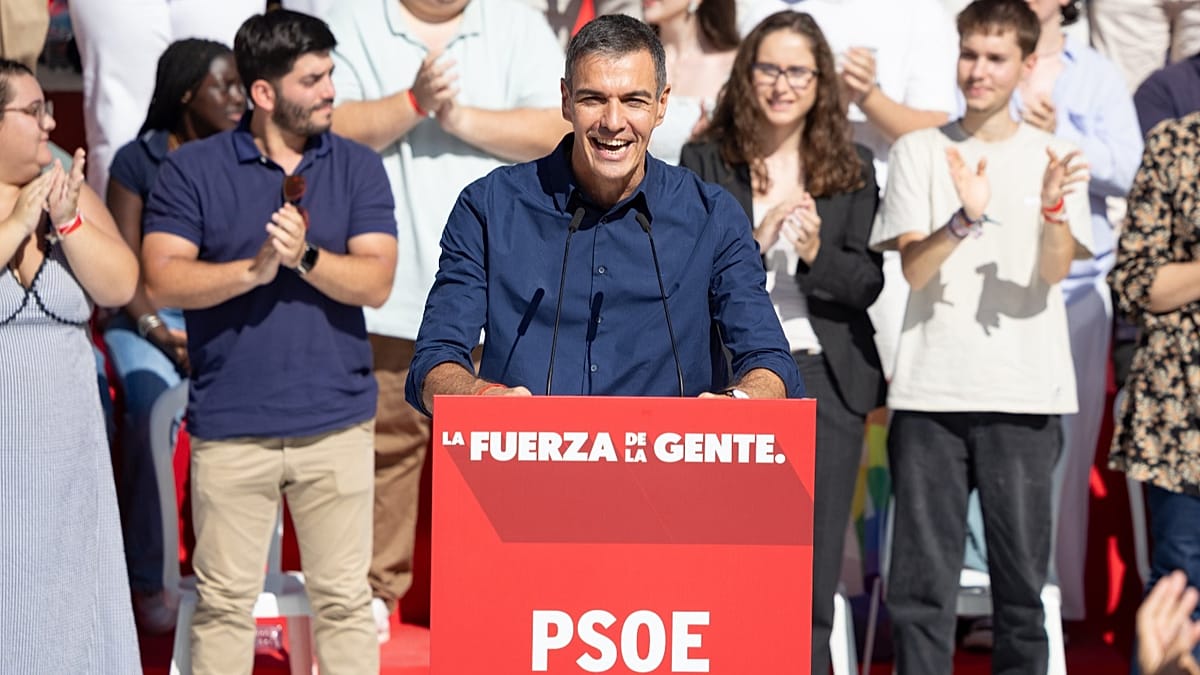
Spanish Prime Minister Pedro Sánchez kicked off his election campaign for the 29 November election in Dos Hermanas, Seville, where more than 5,000 people gathered to hear him speak.
ADVERTISEMENT

ADVERTISEMENT
The choice of that town is no coincidence, as it is the largest city in Andalusia where the Socialists remain in power following the most recent regional elections.
It was there in 2017 that Sánchez began his bid to secure the Spanish Socialist Workers’ Party’s (PSOE) general secretariat. His campaigns in 2019 and 2023 also began in what Alejandro Moyano, deputy secretary for Organisation of the PSOE in Andalusia, describes as the party’s “lucky city”.
The Socialists have a long way to go to win back voters after losing the last series of elections: the 2022 Andalusian poll, the 2023 local and general elections, the 2024 European vote and the Andalusian elections earlier this year.
Sánchez paid tribute to Maricarmen Abascal, who has become a symbol of Spain’s housing protests, saying that “the social cause bears the name of an 87-year-old woman”. He also repeated one of her phrases: “What I have suffered, I don’t want anyone else to go through”.
The prime minister described his political opponents as a bloc that has spent eight years spreading “messages of fear”. By referring to the fable of ‘The Boy Who Cried Wolf’, Sánchez drew his own conclusion: “They are the wolf.”
He summed up the dilemma facing the People’s Party (PP) as “susto o muerte” (“fright or death”): if they are in opposition they hurl insults, and if they govern they make cuts.
Opposition leader and People’s Party president Alberto Núñez Feijóo also launched his pre-election campaign in Madrid on Saturday. In his speech, he pledged to give his all for those in attendance and for the millions of Spaniards seeking change.
The People’s Party presdient launched a sharp attack on Sánchez, arguing that he (Feijóo) does not come “from the saunas or the sewers” but from a background in management: from presenting and balancing budgets, maintaining public services and stepping up in good times and in bad.
After Sánchez called an early general election for 29 November, 2,769,645 voters holding a Spanish passport and residing abroad have been called to vote. This represents an increase of more than 19%, or 444,335 more voters than in the 2023 election, underscoring the impact of the so-called “Grandchildren’s Law.”
Since 2023, Spain’s overall electoral register has grown by 1.26 million people, while 1.6 million young people have reached voting age and become eligible to cast their vote for the first time.
Read the full article here