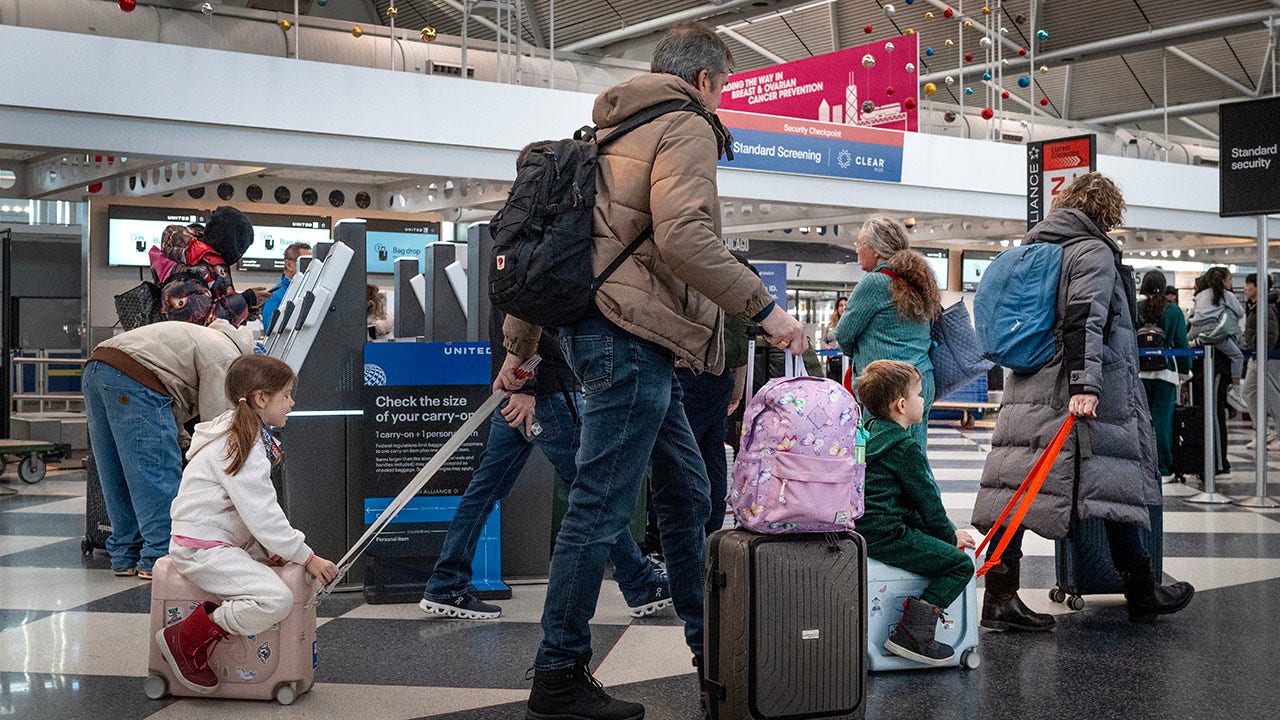




There’s no place like home for the holidays — or the natural slide back into adolescent feelings and behaviors that often accompany being back with family during Christmastime.
Coined by some mental health professionals as “holiday regression,” the tendency to revert to old dynamics, habits and especially anxieties during familial festivities can be an annoying and unsettling one — but Alex Iacovitti, a marriage and family therapist based in Santa Clarita, California, emphasized that it’s not only natural, but expected.
“We really develop who we are as people within our family system,” Iacovitti told The Post. “We learn what parts of us are acceptable, what’s not, what gets us attention … We develop a stronger sense of self as we get older. But when we go back, we’re in this role again where it’s easy to feel that certain parts of us are unacceptable.”
Iacovitti explained that the resulting stress often prompts adult children — many of whom have outgrown old childhood familial roles and have gone on to be highly respected in their professional and personal lives — to go into “fight or flight” mode, which can make it easy to go back to speaking and behaving like an “angsty teenager.”
“In (this state), the logical parts of our brain shut off, and we’re more in a reactive part — so we’re responding out of that reactivity,” said Iocovitti. “Those primitive survival tools you learned as a kid can be reactivated, because you’re going back into an environment where they were very much needed.”
Liz Coin, a 28-year-old NYC actor and comedian who typically spends the holidays with her parents and siblings in Bettendorf, Iowa, loves getting to be with her family for a few weeks during Christmas vacation — but admitted that her temper “gets shorter” the longer she’s visiting home.
“I’m quicker to pick a fight, or turn into an angsty teen,” Coin told The Post. “Like the other day, my dad brought up AI, and I was, like, ‘No, Dad, you don’t understand — AI is going to ruin us all!’ I’ll just get on these teenager-type soap boxes.”
Coin also shared that she sometimes starts “doubting herself” and her adult capabilities the longer she’s in her hometown for the Yuletide season.
“When I’m home for too long, I start feeling like a baby — like I have to ask my parents, ‘Oh, can I do this? Can I borrow the car?’ I start acting like I’m not a grown adult with money who could just drive to the store if I wanted to.”
Coin was not the only one The Post spoke with who admitted to battling blurred boundaries while spending time at home for Christmas.
This year, Lauren Hyland, a 34-year-old Pittsburgh-based mindset coach, is visiting her snowbird parents and brother with her husband and three children in Florida for a two-week period over the holidays. While she’s grateful for the quality time together, she’s had to set boundaries over the years to protect her adult sense of peace.
“A few trips ago, somebody had said to me that I wasn’t disciplining (my kids) harshly enough,” Hyland told The Post. “I had to set an adult boundary and was, like, ‘We are going to parent the way we believe is right. I would appreciate you not stepping in on that.’ … I had to say something that I would have gotten in trouble for saying before.”
However, Hyland now looks back at the tough moment with a certain amount of fondness — sharing that it led to a “great conversation” that deepened her relationship with her family member.
“I think addressing things early and in a calm, neutral manner can really have a huge effect on growing your relationships beyond the foundational stuff, like when you were a kid,” said Hyland.
Hyland also shared that being able to lean on her husband during moments of familial stress has been “the single greatest thing” that’s ever happened to her — a practice called “co-regulation” that Iacovitti emphasized can be helpful to replicate with one’s own partner or a friend during times of tinsel-laden turmoil.
‘If you’re leaning on a partner and telling them, ‘Hey, I feel like I’m back in this environment where my parents aren’t showing up for me, and I don’t feel like I’m seen again,’ then your partner’s able to say, ‘Ugh, I see that, and I’m right there with you,’ ” said Iacovitti.
For those struggling to stay merry in the midst of dysfunctional family dynamics, Iacovitti shared that mental preparation — and a heavy dose of empathy — are two of the best defenses.
“It’s about just telling yourself, ‘Hey, this is likely going to happen when I get into this environment — my body’s going to have a reaction … How are you perceiving some of the messages you’re getting (from family members)? And try to reframe it as, these messages are coming from their own hurt — not my own shortcomings,” said Iacovitti.
Hyland also emphasized that the feeling of regression when one goes back home for the holidays is not a sign of immaturity — it’s just “a memory that’s stored in your body.”
“You can make your own dynamics. You can change them. You can have hard conversations — it’s OK. It’s not the end of the world.”
Read the full article here