

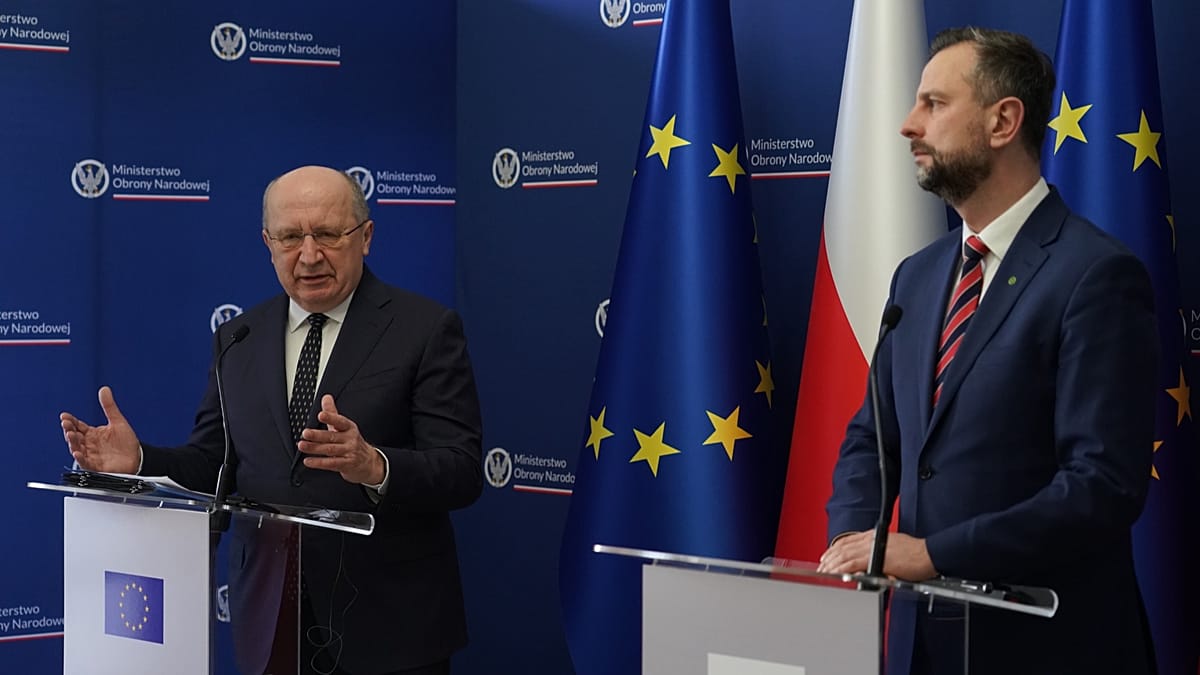
European Commissioner Andrius Kubilius waded into Poland’s political debate on Friday urging Warsaw to approve participation in the EU’s Security Action for Europe (SAFE) defence loan scheme, which has been at the centre of a domestic political row.
ADVERTISEMENT


ADVERTISEMENT
“I am quite surprised about Polish discussions on SAFE,” Kubilius said from Warsaw on the first stop of his “Missile Tour” across the EU. “Saying no to SAFE is saying no to Polish jobs for Polish people.”
Poland is set to receive the biggest allocation (€43.7 billion) out of the €150 billion SAFE programme, which was set up by the Commission as part of its plan to boost defence readiness across the bloc before the end of the decade – the point when some intelligence agencies believe Russia will be prepared to launch an attack on an EU member state.
Poland’s defence investment plan to access the funds has secured the two necessary green lights from the European Commission and the European Council, as well as the country’s parliament and senate, but it is now being held up by President Karol Nawrocki, who must sign it into law.
Nawrocki, from the opposition Law and Justice (PiS) Party, has been arguing that the programme would be a constraint on Polish sovereignty, that it is being piloted by Brussels and Berlin, and that it wouldn’t be advantageous to the Polish economy and companies.
Nawrocki proposes ‘Safe Zero’ alternative
Marta Prochwicz of the European Council on Foreign Relations told Euronews that SAFE had hardly been debated in Poland, where the necessity to boost defence readiness is widely accepted, until the president and his party seized on it in a bid to score political points.
“This is not new for them. This is how they’ve been gaining their voters for a long while now, talking about Polish sovereignty in contrast to Brussels imposing restrictions on Poland,” she told Euronews.
The right-wing populist PiS party has been falling in the polls, according to polling aggregator Europe Elects, and now stands at around 23%, down from 35% in September. Meanwhile, the centre-right Civil Coalition alliance helmed by Prime Minister Donald Tusk is leading, with its popularity gaining in recent months to reach 34% in national polls.
Nawrocki has instead pitched a “SAFE Zero” plan he drew up with the president of the National Bank of Poland which would rely on the financial institution’s foreign currency assets and gold reserves, although details have been scarce.
He argues this would be cheaper for Poland as SAFE is a loan provided by the Commission that Warsaw would have to pay back.
Under SAFE, the Commission, which enjoys a AAA credit rating that most member states cannot match – Poland, for instance, is currently rated A- by Standard & Poor’s – would raise money on the markets to provide long-maturity loans with a maximum duration of 45 years and a 10-year grace period for principal repayments to capitals.
The idea is that this would provide a cheaper way for them to make defence investments.
In his intervention on Friday, Kubilius rejected some of Nawrocki’s arguments, arguing the programme, which includes a stringent Made in Europe requirement, would primarily benefit the domestic economy. He cited comments from Prime Minister Donald Tusk that around 80% of the funds would flow to local industry and “massively boost the economy”.
“Who will lose if Poland does not approve SAFE? Polish people, Polish villages, cities and regions,” Kubilius said. “Saying no to SAFE is saying no to Polish jobs for Polish people.”
Without the programme, he argued, factories may not be built, and the opportunity to expand the European missile industry could be lost.
“If Poland will decide to use taxpayers’ money to buy weapons not from Polish industry, but from somewhere else, it will mean that Polish taxpayers’ money will create jobs also somewhere else,” he also said. The commissioner added that Poland has the potential to develop “the strongest defence industry in Europe” while cooperating closely with Ukraine.
Poland could have ‘best army in Europe by 2030’
Standing next to him, Poland’s Defence Minister Władysław Kosiniak‑Kamysz renewed his call for the country’s SAFE plan to be signed into law, stressing that “contracts have been signed” and that “the programme is ready”.
Unlike SAFE, which he described as “very advanced”, the president’s alternative amounts to the “promise of a new project,” Kosiniak‑Kamysz said. In more conciliatory comments, he then said he is “not interested in choosing between the two”, and that the two programmes could instead “complement” each other.
“If that happens, then we will have the best army in Europe by 2030,” he said.
Nawrocki’s refusal to sign SAFE into law would restrict funding to pure military equipment, Prochwicz told Euronews.
“If we manage to get this law signed by President Karol Nawrocki, a lot of the money will go towards infrastructure projects, not just the modernisation of the armed forces but also military mobility and dual-use infrastructure,” she said.
If the president refuses to sign, however, the way the loans are implemented would likely narrow their scope. In that case, Prochwicz said, the funds would largely flow through the defence ministry alone rather than being spread across multiple ministries working on what she described as a broader “total defence” and national resilience approach.
She added that while Poland has made significant progress on military modernisation, it still lags behind on wider aspects of security such as critical infrastructure, military mobility and cross-border connectivity – as does much of Europe.
Read the full article here