






The European Securities and Markets Authority (ESMA) has warned that many prediction market contracts may already fall under existing restrictions on binary options, saying companies cannot avoid financial regulations simply by marketing them as “event contracts.”
In a public statement on Friday, the regulator reminded companies that event contracts meeting the definition of financial instruments are already prohibited from being marketed, distributed or sold to retail investors under national measures implementing ESMA’s 2018 binary options restrictions.
ESMA said the assessment depends on a contract’s characteristics rather than how it is marketed, adding that event contracts with binary outcomes and fixed payouts are likely to qualify as financial instruments subject to the restrictions.
The regulator also told companies that offering qualifying event contracts to professional or institutional clients still requires authorization under the EU’s Markets in Financial Instruments Directive, or MiFID II, regardless of whether retail investors are excluded.
Excerpt from ESMA’s July statement on event contracts. Source: ESMA
The statement does not introduce new restrictions. ESMA said it issued the reminder after observing increased offerings of event contracts and the rapid growth of prediction markets, noting that qualifying binary options have already been subject to national restrictions across the EU since 2018.
Related: StanChart joins ESMA’s first MiCA register update since deadline
US prediction markets face growing legal battle
In the United States, a regulatory battle over prediction markets is unfolding, pitting state gaming regulators against the Commodity Futures Trading Commission (CFTC) over whether event contracts should be treated as gambling or federally regulated derivatives.
By March, authorities in 11 states had taken legal or regulatory action against platforms including Kalshi and Polymarket. Nevada became the first state to temporarily block Kalshi’s operations, while Arizona brought criminal charges alleging the company was operating an illegal gambling business.
The following month, the CFTC asserted “exclusive jurisdiction” over prediction markets, saying Congress had entrusted the agency with sole authority to regulate commodity derivatives markets, including event contracts. The regulator also said it had sued several states and filed court briefs supporting platforms, including Kalshi.
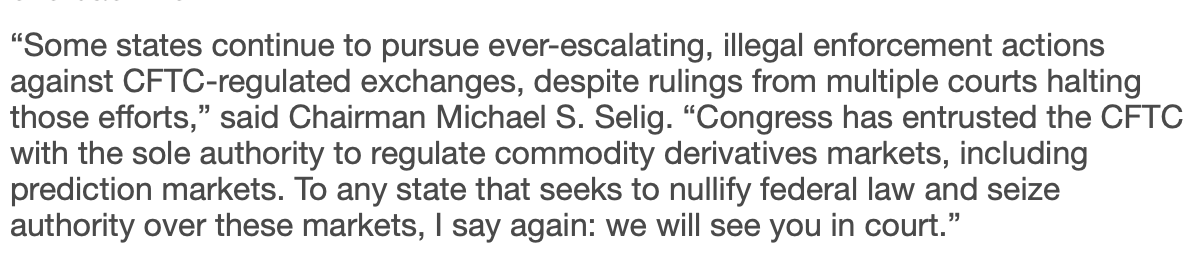
The CFTC’s April announcement defending its authority over prediction markets. Source: CFTC.gov
The legal battle has continued to escalate. On June 30, a Massachusetts judge allowed state authorities to file an amended complaint against Kalshi in an ongoing lawsuit alleging that the company’s sports-event contracts constitute illegal gambling under state law.
The dispute has also prompted calls for congressional action. Last month, the Indian Gaming Association and American Gaming Association, joined by tribal and labor groups, urged lawmakers to amend the CLARITY Act to explicitly prohibit sports-related event contracts on prediction market platforms, arguing they fall outside the CFTC’s authority and should remain subject to state gambling laws.
Some legal experts believe the growing conflict between federal and state regulators over prediction markets could ultimately be decided by the US Supreme Court.
Magazine: Bitcoin slides to $58K, XRP hits $1 but onchain data promising: Market Moves
Read the full article here