






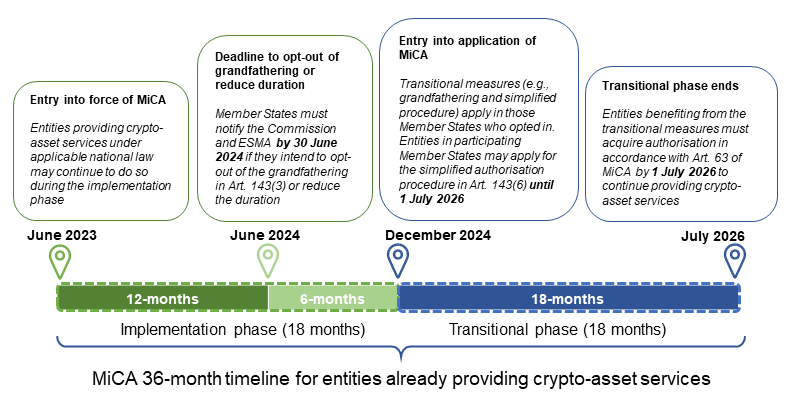
The European Union’s cryptocurrency industry has entered a new enforcement phase as the transition period under the Markets in Crypto-Assets (MiCA) regulation came to an end.
The end of the transition means crypto companies without MiCA authorization can no longer legally serve EU clients and are expected to wind down operations or face multimillion-euro fines and other enforcement action.
Industry executives and lawyers told Cointelegraph the next challenge is ensuring national regulators apply the bloc’s single rulebook consistently, even as supervisory approaches are expected to vary across member states.
The transition marks MiCA’s first major enforcement test as regulators begin applying the EU’s crypto rulebook.
MiCA compliance costs versus fines
Although complying with MiCA can cost hundreds of thousands or, in some cases, millions of euros, experts say operating without authorization carries far greater financial and regulatory risks.
Nicola Massella, partner at Storm Partners, estimated MiCA implementation costs for many cryptocurrency companies at 350,000 euros ($400,000) to 600,000 euros ($690,000), while Brickken CEO Edwin Mata said costs can reach 2 million euros ($2.3 million) depending on a company’s size, services and compliance readiness.
On penalties, Eckehard Stolz, managing director of Amina EU, said MiCA penalties start at 5 million euros or 5% of annual turnover for some violations.
Source: EBA
Massella added that the European Banking Authority (EBA) proposed on June 26 increasing penalties under certain regulatory regimes, including as much as 12.5% of annual turnover for some stablecoin-related breaches.
Who enforces MiCA?
While MiCA creates a single EU rulebook, day-to-day supervision is handled by national competent authorities (NCAs), which authorize, supervise and enforce the rules for crypto companies.
The European Securities and Markets Authority (ESMA) coordinates supervision across member states and maintains the public register of authorized crypto-asset service providers, and the EBA directly oversees significant stablecoin issuers.
Source: ESMA
“At the EU level, ESMA plays an important coordination and supervisory-convergence role, especially to avoid regulatory arbitrage between member states,” Ivo Grlica, founder of GrlicaLaw and G Lab Advisors, told Cointelegraph.
“National regulators are only the first line of MiCA enforcement, but the legal consequences can spread into national courts and criminal-law systems if the underlying conduct causes harm,” he added.
Enforcement unlikely to be uniform at first
MiCA enforcement is unlikely to be uniform in its early stages because NCAs differ in resources, experience and supervisory priorities.
“ESMA made clear it expects NCAs to act against unauthorized providers from July 1,” Stolz said, adding that how aggressively each regulator moves “will depend on local resourcing and priorities.”
Peter Bidewell, vice president of institutional product adoption at Parfin, said differing supervisory approaches could create opportunities for regulatory arbitrage despite MiCA’s goal of harmonizing crypto rules across the EU.
Related: StanChart joins ESMA’s first MiCA register update since deadline
Grlica said he expects enforcement to become more systematic over time as regulators identify unauthorized providers and share information across member states, making it increasingly difficult for companies with a history of non-compliance to obtain MiCA authorization later.
Several EU regulators, including authorities in the Czech Republic, Bulgaria, Luxembourg and Italy, have issued notices reminding crypto companies that the MiCA transition period has ended and urging providers without authorization to wind down their operations.
The Czech National Bank told Cointelegraph that the country’s Financial Market Digitization Act gives it the authority to impose sanctions for MiCA-related violations, including operating without authorization, unlawful token offerings and failing to cooperate with supervisors. The law allows the central bank to fine companies providing crypto services without authorization up to 118.5 million Czech koruna (about $5.6 million), 5% of annual turnover if higher, or twice the unlawful benefit obtained, whichever is greater.
Cointelegraph contacted France’s Autorité des marchés financiers (AMF), the Netherlands’ Authority for the Financial Markets (AFM) and Germany’s Federal Financial Supervisory Authority (BaFin) to ask how they plan to enforce MiCA following the transition deadline. None had responded by publication.
Magazine: How crypto laws changed in 2025 — and how they’ll change in 2026
Read the full article here