





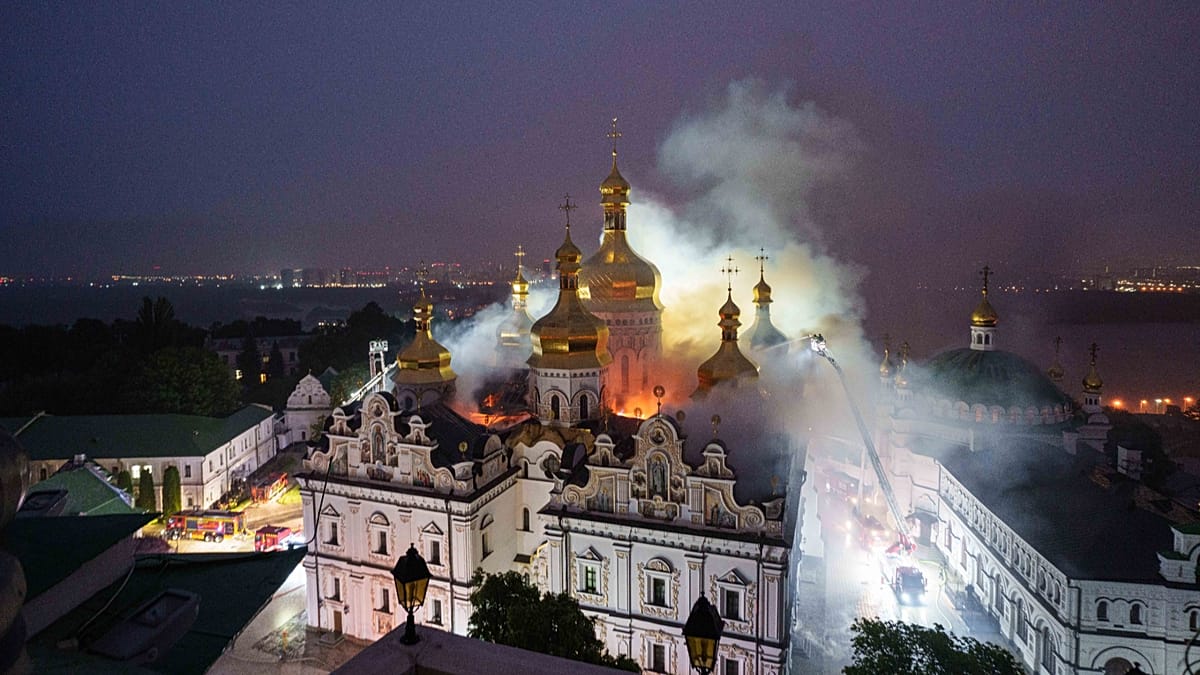
Pro-Russian social media users have shared fake images they claim show evidence that photographers were preparing in advance to capture a strike on one of Ukraine’s most important religious sites.
ADVERTISEMENT


ADVERTISEMENT
The posts allege that the presence of the camera crews on nearby rooftops shows that the attack on the Kyiv-Pechersk Lavra was staged by Ukraine.
The monastic complex was hit between 14 and 15 June, when Russia fired a barrage of drones and missiles at Ukraine’s capital, Kyiv.
Authorities said that five people were killed and residential areas were hit when missiles struck and damaged both the UNESCO-listed monastery complex and the Oleksandr Dovzhenko Film Studios.
Founded in the 11th century, the sprawling complex of monasteries and churches is one of Ukraine’s most significant Orthodox-Christian sites.
A video from the aftermath of the strike posted by Ukrainian Prime Minister Yulia Svyrydenko showed the Dormition Cathedral in flames.
In the strike’s aftermath, Russian authorities said the strike was Ukraine’s fault, and that the cathedral was damaged by a US-made Patriot missile.
Some social media users also claimed in several posts on X, Facebook and TikTok that the attack was staged by Ukrainians, attaching two photos.
One shows two men setting up a tripod on a roof, aiming it towards the cathedral. The second claimed to show a man taking a photo of the strike’s aftermath, with the roof engulfed in flames.
The Cube, Euronews’ fact-checking team, found examples of these posts shared in German and Greek. These posts accumulated more than 11,0000 views across platforms, accusing the cameramen of being aware of the strike in advance.
“Filming of bombardments in Ukraine is prohibited,” one post claimed. “However, it was precisely on this night that photographers with professional equipment ended up on the roofs of buildings neighbouring the Lavra in Kyiv.”
The Cube analysed both images using OpenAI’s image verification tool, which detected a SynthID watermark embedded within each file.
SynthID is an invisible digital watermark added to images generated by OpenAI’s image generation models, allowing them to be identified even after being shared online.
The images also contain visual inaccuracies. They depict the cathedral’s roof as green, whereas verified images of the complex show it is brown (with some green roofs belonging to other buildings nearby).
Ukraine’s Security Services (SBU) said that Russia was responsible for the attack, which it said was caused by a Geran-2 unmanned aerial vehicle.
No evidence has emerged to support claims that the attack was staged or that Ukrainian photographers had prior knowledge of the attack.
Ukrainian President Volodymyr Zelenskyy described the attack as “one of Russia’s most serious crimes against Christian culture to date,” whilst Foreign Minister Andrii Sybiha also announced that Ukraine would initiate procedures within UNESCO and “other international mechanisms” to demand a response from “Russian terrorists”.
French President Emmanuel Macron also commented on X that, “just like the war of aggression that Russia has been waging against Ukraine for more than 4 years, nothing justifies this attack on our universal heritage.”
Read the full article here