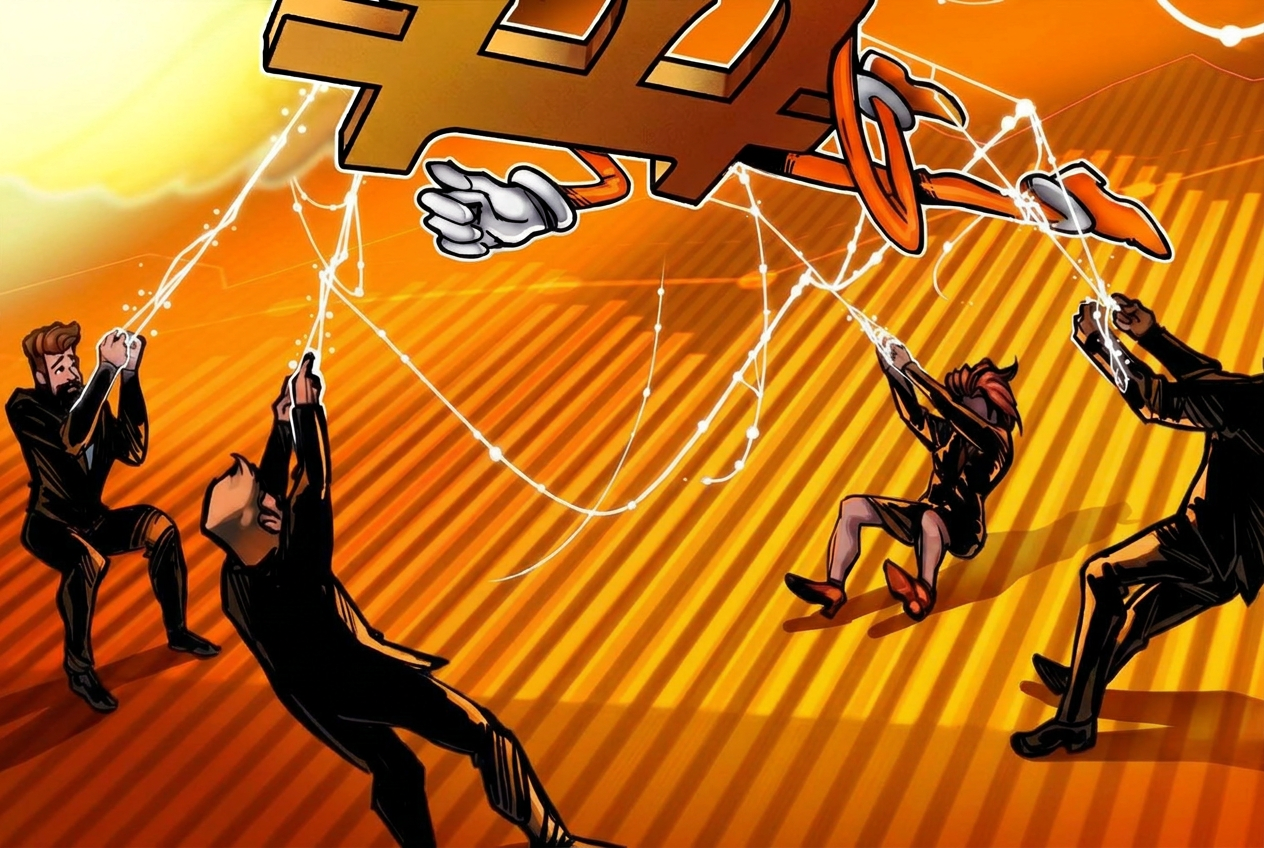







Bitcoin ‘anti-spam’ BIP goes nowhere fast
Supporters of the BIP-110 soft fork hoped to eradicate spam from the blockchain, but after a lengthy and heated debate the proposal has been pronounced Dead On Arrival. After securing just 2.5% support ahead of entering mandatory signaling on Saturday, it split off into a minority chain that mined just two blocks in eight hours before stalling.
This is probably no surprise given it’s just as difficult and expensive to mine on the new chain as it is on Bitcoin — but without any hope of being able to sell the block reward to recoup the costs. The difficulty would have adjusted downward if they’d managed to mine through another 2,014 blocks.
BIP-110 aimed to rid Bitcoin of non financial transactions, such as Ordinals, but opponents saw it as imposing censorship on the chain and it faced opposition from prominent Bitcoin advocates. Strategy executive chairman Michael Saylor said he shared the proposal’s objectives but argued that its approach threatened Bitcoin’s neutral rules and consensus.
Blockstream CEO Adam Back warned that the consensus-level change could damage Bitcoin’s credibility and potentially make certain unspent transaction outputs unspendable. Bitcoin Core developer Murch has subsequently proposed removing BIP-110 backer Luke Dashjr from his position as a BIP Editor.
Clarity vote gets punted to September
Senator Tim Scott, who chairs the Senate Banking Committee, said on Thursday a procedural vote on the CLARITY Act should happen before the August recess “without any question.”
Senator Cynthia Lummis also raised hopes of a last minute vote. But despite hopes the Senators would locked in a room and forced to compromise before leaving for the August break, Senate Majority Leader John Thune declined to force the issue and later scheduled the cloture vote for September 15.
“The Dems are insistent on no Clarity vote,” Thune told Cointelegraph. “I worked with sponsors of the bill. Senator Lummis was great, and we’re getting that queued up first thing when we come back.”
Crypto lobbyists have until then to shore up the 60 votes required by negotiating on ethics rules, the stablecoin yield issue, and protection for developers in the BRCA. The real question though is whether it will be a serious attempt to pass the legislation, or if the vote has been called simply “to get people on the record” ahead of the mid-term elections as Lummis suggested.
Bitcoiners form ‘red team’ to battle AI-assisted hacks
A Bitcoin security group made up of 16 volunteers said mid-week it had found nearly 5,000 potential issues during a rapid AI-assisted review of projects in the Bitcoin ecosystem.
By the weekend that number had grown to 7,958 issues, with 168 critical flaws and 1,120 high severity issues.
Bitcoin Red Team is a volunteer security effort that includes Rob Hamilton, CEO of AnchorWatch and Bitcoin developer Calle, which has been using AI tools and human review to scan open-source Bitcoin-related repositories for vulnerabilities.
“We’re averaging on the order of 1 critical exploit per hour per person,” said Calle in a post.
The team sprang into action as a result of the Coldcard hardware wallet hacks, which developer Coinkite suggested were the result of an AI analysis of its source code. More than $100 million has been stolen by 7300 wallets, due to flaws in the random number generated used to generate seed phrases. It has become the third largest crypto hack in 2026 and helped push July’s crypto thefts total to $247 million.
The incident helped shine a light on the trust required with using a hardware wallet, and led many Bitcoiners to wonder if any wallet was truly safe?
Many are now determined to use at least 100 manual dice rolls to generate their own seed phrase.
Ethereum researchers want to rein in staking; critics say it could backfire
A group of Ethereum researchers and developers have proposed changing the network’s issuance policy to cut validator rewards more sharply as the proportion of staked ETH rises.
Tapered Issuance Burn (AKA EIP-8363) would cut rewards entirely as the percentage of supply staked crossed the 50% mark. It’s currently at 34% with a huge queue of ETH waiting to enter, and there are fears this may continue to snowball while providing progressively less benefit for the security of the network.
Despite offering some compelling arguments in favor of the proposal, it has been met with a fierce backlash, especially from DeFi protocols. Ether.fi founder Mike Silagadze suggested Ether.fi would get out of staking entirely if it goes through. He said:
“This is so disappointing on every level. […] This is bad for decentralization, this is bad for Ethereum adoption, and this is bad for the credibility of the network.”
Happy days are here again as Bitcoin ETFs see best week in four months
The spot Bitcoin exchange-traded funds registered their third-strongest showing since October as institutional demand showed signs of renewed momentum.
The haul of $853.54 million in inflows was five times the amount they netted across all of July, and was the best week since April. The Ether ETFs took in another $243.7 million.
Some industry figures believe the large inflows may be related to the Coldcard hack, which has made institutional custody more attractive than using a potentially insecure hardware wallet. Bloomberg ETF analyst Eric Balchunas suggested there may be a connection, while Binance co-founder Changpeng “CZ” Zhao said point blank: “It is statistically safer to store coins on exchanges than to self custody.”


Winners and Losers
At the end of the week, Bitcoin (BTC) is up 2% to trade at $64,814, Ethereum (ETH) is up 1.7% to trade at $1,908 and XRP (XRP) is down 5% to $1.02. The total market cap is at $2.21 trillion according to CoinMarketCap.
Among the biggest 100 cryptocurrencies, the top three altcoin winners of the week are Pump.fun (PUMP) with a 27.6% gain, LayerZero (ZRO) on 17.6%, and Curve DAO (CRV) on 16.2%.
The top three altcoin losers of the week are Injective (INJ) which was down 15.1%, Canton (CC) down 13.8% and Cronos (CRO) down 13.7%.
Prediction of the Week
Bitcoin will never fall below $60K again: Nansen founder
Nansen founder and CEO Alex Svanevik says the Bitcoin market may be approaching a bottom, suggesting that the current level around $60,000 could mark Bitcoin’s cycle low.
“My personal view is that I don’t think Bitcoin’s gonna go back below $60,000,” Svanevik says. “I think that’s the past… I think forever,” he says.
He bases this on the belief that Bitcoin serves as a hedge against central bank money creation, and he doesn’t see the global monetary expansion cycle coming to an end anytime soon.
Top FUD of the Week
Crypto wrench attacks net more than $30M so far in 2026
Criminals stole more than $30 million through physical attacks on crypto holders in the first half of this year, putting 2026 on pace to surpass the record $58 million stolen in 2025.
Chainalysis reports that 46 violent crypto-related incidents had been documented globally through late June, up from 40 during the same period in 2025. The incidents include kidnappings, home invasions and hostage situations, collectively known as “wrench attacks.”
Only 12 of the 46 attempts resulted in payment, giving attackers a 26% success rate, down from 49% in 2025.
ElizaOS token sinks 19% to record low after founder declares it ‘dead’
ElizaOS fell 19% over 24 hours to an all-time low after Eliza Labs founder Shaw Walters said the token was “dead” and that the Eliza Foundation was winding down.
CoinGecko data showed the token now has a market capitalization of $2.1 million.
“The token is dead. Completely,” Walters said, adding that he no longer owned or supported the token.
The decline represents a stark reversal for one of the AI-agent sector’s former breakout tokens. Before the project rebranded as ElizaOS, the token, then known as AI16Z, reached a peak market capitalization of $2.5 billion in January 2025, according to CoinGecko.
Walters said the development of the open-source Eliza software would continue without the token or the foundation.
CEX perpetual futures volume falls to $4T, lowest since late 2023
Crypto perpetual futures trading volume on centralized cryptocurrency exchanges (CEXs) fell to $4 trillion in July, marking a 31-month low.
Binance led CEXs with $1.4 trillion in monthly perpetual futures volume, followed by OKX with $607 billion and Bybit with $300 billion, analytics platform CryptoRank said in a Friday X post.
Perpetual trading volume on decentralized exchanges (DEXs) fell to $531 billion in July, the lowest level since June 2025, and a 21% decline from the $676 billion seen in June 2026, according to data aggregator DefiLlama.
Best Magazine Features of the Week

The Coldcard entropy flaw caused a crisis of confidence in hardware wallets. Here’s the details you need to know before you entrust Ledger, Trezor or Foundation with your Bitcoin.
Tokenized cows may have gone viral, but they’re just the latest in a long line of strange things to find a home onchain, from farts, to human skin and destroyed artworks
Ethereum’s proposed EIP-8363 staking overhaul aims to reduce issuance, but critics say it could hurt DeFi, decentralization and institutional adoption.
Cointelegraph publishes long-form journalism, analysis and narrative reporting produced by Cointelegraph’s in-house editorial team with subject-matter expertise. All articles are edited and reviewed by Cointelegraph editors in line with our editorial standards. Some articles contain affiliate links, from which Cointelegraph may earn a commission. These relationships do not influence which products we review or our editorial conclusions. Content published in here does not constitute financial, legal or investment advice. Readers should conduct their own research and consult qualified professionals where appropriate. Cointelegraph maintains full editorial independence.
Read the full article here