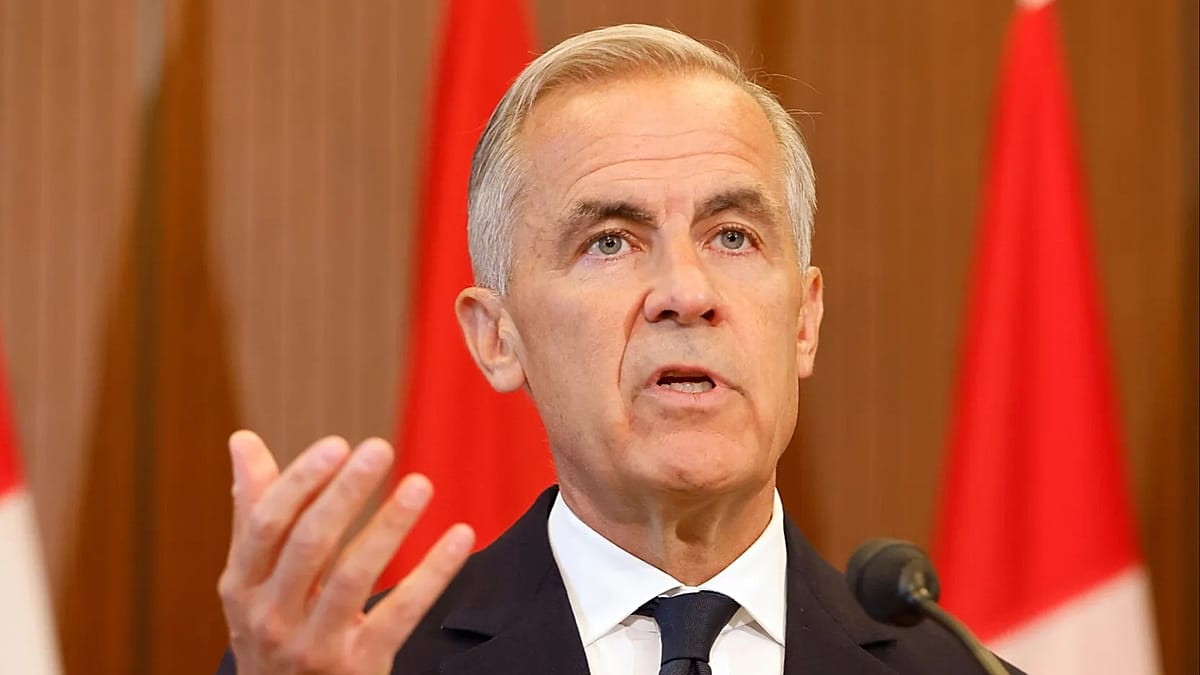



With the trade war with the US heating back up, Canada’s Prime minister Mark Carney has delivered another pledge to deepen his country’s economic and security partnership with the EU.
ADVERTISEMENT


ADVERTISEMENT
His statement came after trade talks between Ottawa and Washington collapsed last week, with Canada accusing the US of interfering in its sovereignty by demanding French-language concessions.
In retaliation, US President Donald Trump said on Truth Social that on 1 January 2027, tariffs on cars and trucks will be increased to 50%.
“WE DON’T NEED CANADA, THEY NEED US!” he wrote. “They do 95% of their business with the US, with us, the exact opposite!”
Canada announced later that, as of 8 September, it would enact tariffs ranging from 15% to 50% on over 700 American imports, worth about $20 billion (€17.2 billion).
Since Trump’s return to power in 2025 and his repeated attacks on US-Canada trade relations, Ottawa has been turning several times towards the EU, seeking a stable relationship with a “like-minded” partner.
“This fall we will begin intense discussions with the European Union, the world’s second-largest economy, to build a much stronger and deeper economic and security partnership,” Carney said on Monday.
The Canadian Prime minister has confirmed, according to Politico, that he will attend the State of the EU speech in Strasbourg on 16 September after European Commission President Ursula von der Leyen invited him before the trade war with the US broke out.
Since the start of the second Trump administration, Brussels and Ottawa have shared a common objective: diversifying their trade relations away from Washington. But since the EU and Canada are already bound by a trade agreement, how far could a deeper relationship go?
The truth is that both sides have their limits.
Intertwined Canadian and US markets
From critical raw materials to energy and defence, the last months have seen multiple areas of interest come to the fore, and they will likely set the agenda at the Canada-EU summit this fall.
Canada is planning to offer the EU better access to its critical raw materials. Brussels is desperate to move away from China, which holds the monopoly on the production and processing of rare earths. With strong domestic supplies of lithium, graphite and nickel, Ottawa has a lot to offer to integrate the EU into its metal value chain.
Canada might also make offers on energy, which it currently supplies principally to the US.
“We should be talking about a more viable Canada-EU corridor for energy, and not just in respect of oil and gas, but also of nuclear,” Mark Camilleri, President of the Canada-EU Trade and Investment Association, told Euronews. “The EU’s energy needs are increasing, and its energy supply is still very dependent on imports.”
On defence, Canada is already part of SAFE, the €150 billion defence instrument that supports EU member states that wish to invest in defence industrial production through common procurement. But defence cooperation is already set to go further, with Canada selecting German-Norwegian TKMS to build a new fleet of 12 submarines. Deepening the relationship on Arctic security could be another area of collaboration.
Canadian business, meanwhile, is increasingly interested in the European market, but the diversification will not come overnight. Geography, after all, matters.
“The Canadian economy is very much oriented and integrated to the US and North American economy,” Camilleri added. “We are not looking to untangle the relationship, despite the very distressing political issues taking place.”
The Europeans will also put limits on integration with Canada. The trade agreement struck in 2016 is proof enough that the EU market is not easy to access: the deal has not yet been ratified by all EU member states, and has only been provisionally applied since 2017.
Faint EU membership hopes
Geography matters not only for the Canadians, but also for the EU.
Article 49 of the Treaty on European Union opens membership to “any European State”. Morocco was not considered European enough in the past to become a member, so how could Canada, located much further away, be considered a “European state”?
Guntram Wolff, senior fellow at the Brussels-based think tank Bruegel, points out that there is a new openness in Brussels, and that a strategic alignment “could go far”, even if probably it has to fall short of full membership.
Liberalising trade further than what the current agreement involves could be an option. But how far could the integration of the Canadian market into the EU go?
“One can go to the point where Norway is, which is a single market membership,” Wolff told Euronews. “Whether that is where Canada wants to go and whether that’s where all the European countries want to go, we will see in the coming weeks.”
Norway, Iceland and Liechtenstein are members with EU member states of what is called the “European Economic Area”, membership of which involves the implementation of the EU’s four freedoms – free movement of goods, persons, services and capital. These freedoms form the basis of the single market.
But an EU official told Euronews that this option was not on the table yet, and remains a theoretical debate for now.
Read the full article here