


For now, suspending the right to asylum in the European Union is still only under consideration.
ADVERTISEMENT

ADVERTISEMENT
But the prospect is already setting off alarm bells among some left-wing politicians and those on the front lines of Europe’s asylum system, who fear that suspending a fundamental right of the EU would be both unprecedented and dangerous.
Earlier this month, Commission President Ursula von der Leyen proposed in her State of the Union speech to introduce an emergency framework that could pave the way for the suspension of the right to asylum, a controversial measure that some capitals have already endorsed.
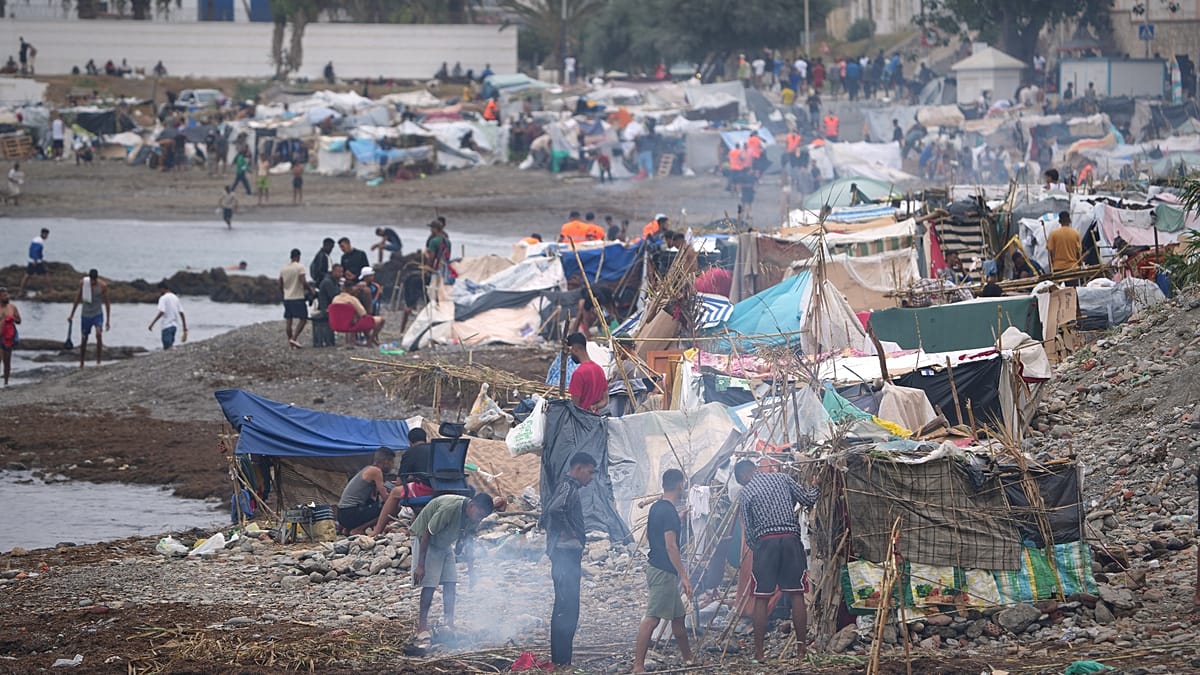
The proposed framework is a response to the Ceuta crisis, following the mass entry of 82,000 irregular migrants from Morocco in late July, with several thousand of them who are still in the Spanish exclave, waiting for their applications to be assessed.
A suspension of the right to seek asylum would be unprecedented at EU level, marking a radical departure from existing migration policy and prompting a major backlash.
Under current rules, any foreign national present in an EU country is entitled to apply for asylum, regardless of how they entered the bloc, with each claim assessed on an individual basis.
Changing the asylum principle would result in allowing “collective pushbacks”, with migrant people sent back outside the EU, irrespective of their personal situation.
According to the UN Refugee Agency (UNHCR), this practice would breach the principle of non-refoulement and migrant’s fundamental rights, as people could be returned to a place where they would face torture, inhuman treatment and threats to their life or freedom.
“Even at times of migratory pressure, States must ensure that people seeking asylum have access to asylum procedures and cannot deviate from this important principle of international law,” UNHCR told Euronews in a statement.
Von der Leyen said the emergency framework would only be triggered “under a strictly defined set of criteria” and “allow for time-limited and strictly defined flexibility in standard procedures.”
A Commission official told Euronews there is no clear timeline for presenting the proposal, and details remain unclear. The topic is likely to be discussed on Saturday at a Migration Conference in Munich, which features ministers and representatives from 18 European countries, the official said.
Meanwhile,civil society groups and MEPs are already pushing back against any mechanism that would allow governments to sidestep existing asylum safeguards.
“This would mean dismantling another piece of EU values,” Italian Socialist MEP Cecilia Strada, a prominent voice on migration issues, told Euronews. She argued that “exceptional circumstances” are simply an excuse to justify pushbacks, which are illegal under EU law.
In various judgments, the European Court of Human Rights has condemned Greece, Lithuania and Poland for this practice.
“This exposes people to being pushed back to places where they would face violence or death,” Michele LeVoy, director of the NGO PICUM (Platform for International Cooperation on Undocumented Migrants), told Euronews.
However, the massive influx of irregular migrants into Ceuta sparked a broader debate over the right to asylum. As the crisis unfolded, several countries called for an emergency meeting, while Italy even reintroduced air and maritime border controls with Spain for a month, disrupting free movement within the Schengen area.
In addition, some countries have not shied away from suspending the right to asylum in the past.
Greece suspended the processing of asylum claims for one month in March 2020 and again for three months in July 2025, after a sudden increase in arrivals by sea from Eastern Libya.Poland imposed a similar measure on migrants crossing its border from Belarus in March 2025, during the peak of the weaponization of migrants by Russia and Belarus.
In both cases, national parliaments approved the temporary suspension, and the EU did not challenge the measures.
When the first one took place, von der Leyen did not criticize the measure. During a controversial visit to the border with Türkiye, she even described Greece as “Europe’s shield.”
“Given her record, we have to expect a mechanism that lets member states suspend asylum whenever they decide a border is under pressure,” Iftach Cohen, co-director of the NGO Front-Lex, told Euronews.
Von der Leyen said last week that the EU “will always comply with its values and fundamental rights” while protecting its external borders.
But other MEPs remained unconvinced.
“By making that point, von der Leyen echoes once again the xenophobic and populist rhetoric that far-right political groups have been using for years,”Greens/EFA French MEP Mélissa Camara told Euronews.
The Left’s French MEP Damien Carême said he is ready to launch legal action to enforce fundamental rights, arguing that “von der Leyen appears to have forgotten they exist”.
The Ceuta incident came against a broader backdrop of declining asylum applications and irregular arrivals across Europe, with both figures falling since 2023.
Read the full article here