






China’s Supreme People’s Court (SPC) said it will study new adjudication rules for virtual currency and cross-border finance cases as part of a broader push to clarify how courts handle digital economy disputes.
“We will conduct in-depth research on the adjudication rules for new cases such as virtual currencies and cross-border finance, formulate judicial interpretations on civil compensation involving insider trading and market manipulation as soon as possible,” said Liu Guixiang, Judicial Committee member of the SPC, during a press conference, reported Chinese news outlet Yicai on Wednesday.
The court also plans to study judicial protection rules for artificial intelligence cases and data property rights, including disputes involving data ownership, data transactions and AI-generated content.
The development aims to draft clearer internal judicial standards on how courts should decide disputes and liability in crypto and AI intellectual property rights-related lawsuits. The promised guidelines may improve the court’s consistency in the growing number of crypto and AI-linked cases in the country.
The comments come months after a high-profile lawsuit involving Chen Zhi, the Chinese-born founder and chairman of Cambodia’s Prince Group, who was arrested in Cambodia on Jan. 6, 2026, and extradited to China shortly after, where he faces charges related to operating pig butchering scam compounds.
In October 2025, the US Department of Justice seized about $15 billion worth of Bitcoin (BTC) from Zhi’s suspected operations.
US authorities charge Chen Zhi and seize $15 billion in Bitcoin. Source: Justice.gov
China’s ban on all crypto transactions remains in place
Mainland China has had a rocky relationship with the cryptocurrency industry.
In December 2013, the People’s Bank of China (PBOC) banned financial institutions from offering Bitcoin-related services and stated that Bitcoin was not recognized as a currency, in its first major prohibitive step against the crypto industry.
Related: South Korean funeral company records $33M unrealized loss on leveraged ETH ETFs
In September 2021, ten Chinese agencies, including the central bank and securities regulators, issued a blanket ban on all crypto transactions, Bitcoin mining and activities tied to initial coin offerings (ICOs) in the country.
In February, the PBOC banned the issuance of unauthorized offshore Chinese yuan-pegged stablecoins and the unapproved issuance of tokenized real-world assets (RWAs).
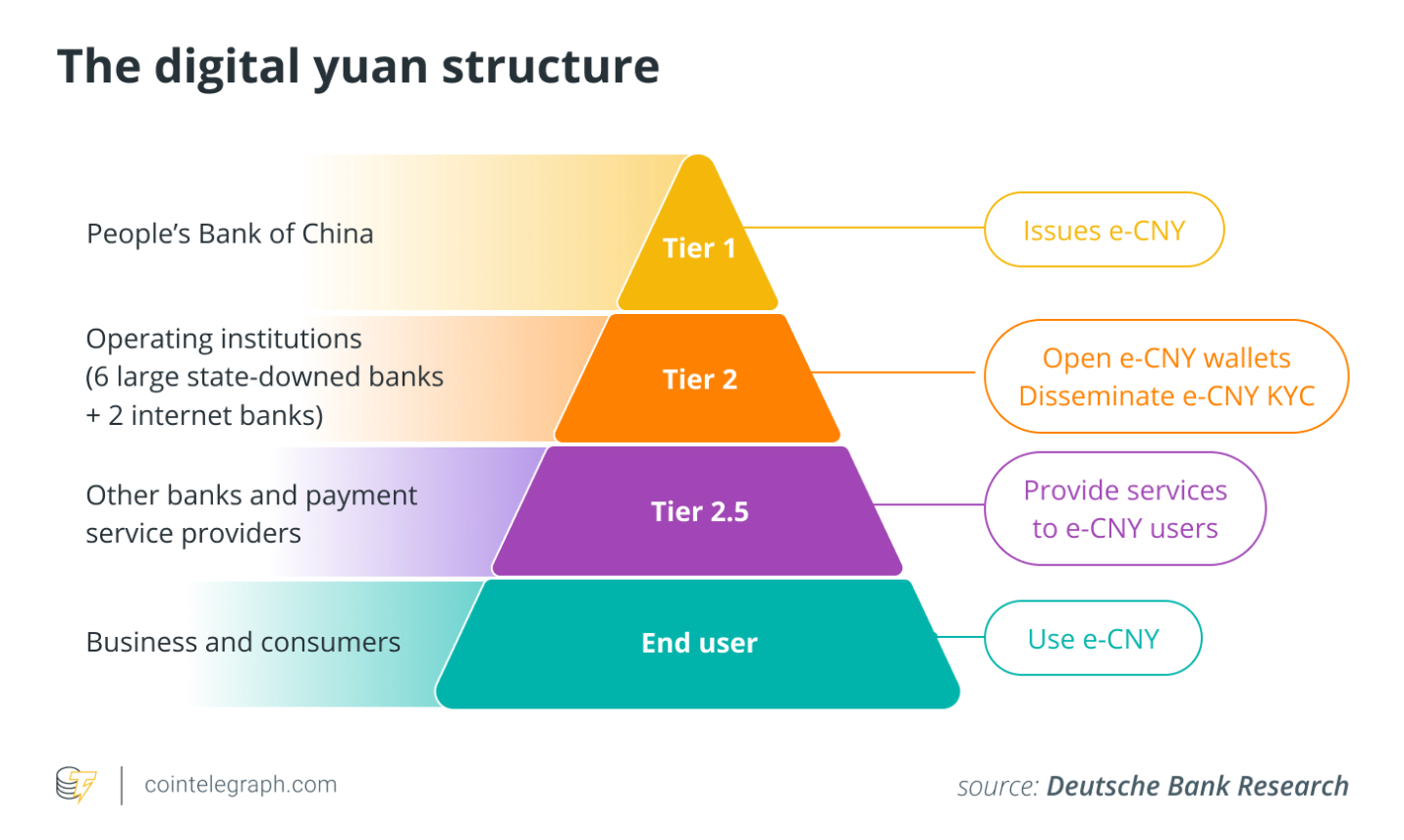
The structure of the digital yuan, China’s CBDC. Sources: Cointelegraph
The latest ban came shortly after the Chinese government approved commercial banks to share interest with clients holding the country’s digital yuan, a central bank digital currency (CBDC) managed by state authorities.
The development signal that the PBOC is doubling down on its efforts to launch its own yuan-backed CBDC as a new form of digital fiat money, instead of stablecoins.
Magazine: 50K investors fight Korean crypto tax, Singapore cancels Bsquared: Asia Express
Read the full article here