




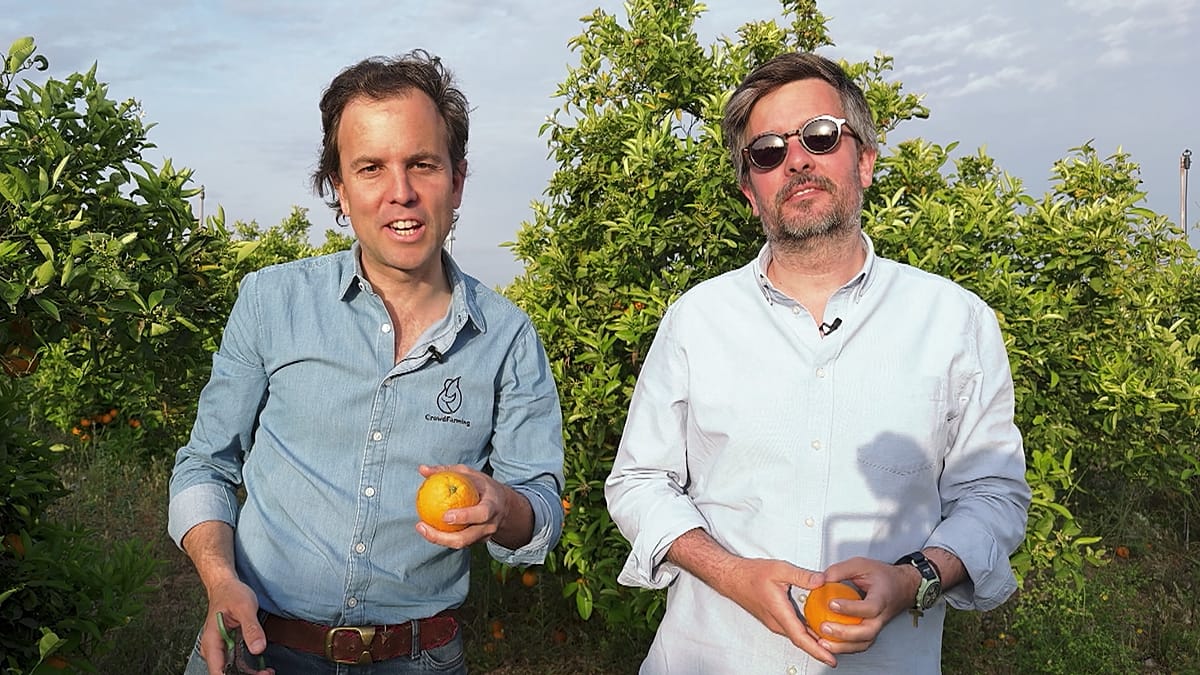
The last day of the harvest season begins in the orange groves of Masia El Carmen, in Bétera, north of Valencia.
ADVERTISEMENT


ADVERTISEMENT
In the soft early morning light, Gonzalo and Gabriel Úrculo move between the rows of orange trees on the farm inherited from their grandfather. Pruning shears in hand, they help workers fill crates that will be shipped later that same day to customers across Europe.
“Neither we nor our grandfather ever imagined we would become farmers,” Gonzalo says. But after their grandfather’s death, the family farm was left abandoned.
With no formal agricultural training, the two brothers decided to revive the farm in 2010, switching to regenerative organic farming.
Today, they run Europe’s largest direct-sales platform for organic agricultural products.
Part of the company’s success is built on a tree adoption system offered to customers. For an annual fee, adopted trees are maintained by the farm, and their fruit is shipped directly to their “adopters”.
“Tree adoptions help us secure a certain stability in demand,” explains Gabriel.
After testing the model on their own farm, the Úrculo brothers launched CrowdFarming in 2017. The platform now allows customers to buy fruit, vegetables, olive oil and nuts directly from partner farmers across Europe, or on local markets.
“On the website, customers can choose the farm and know exactly who the farmer behind it is,” Gonzalo says. “We create a direct connection between farmers and consumers.”
Today, the company has more than 300,000 active tree adoptions and works with over 300 partner producers across Europe.
One of them is Fernando Agramunt, manager of an organic olive farm that switched from conventional to organic farming several years ago.
He says the move has paid off thanks to direct sales.
“Selling 10,000 litres in bulk is not the same as selling to families willing to pay a bit more for very high-quality olive oil,” he explains.
The model also helps absorb the higher costs associated with organic and regenerative farming methods, Fernando adds. “And our entire harvest is sold to the 3,000 customers sponsoring trees on the farm.”
Another source of savings for producers comes from CrowdFarming’s logistics hubs. The largest one, Crowd Log, is based in Valencia.
Thousands of orders are sorted, packed and shipped there every day.
“Last year, nearly two million parcels were shipped from here. We don’t keep stock, and we work with several transport companies, which allows us to move faster,” says site manager Clara Fernandez.
In 2024, CrowdFarming posted revenues of 65 million euros. Following the recent acquisition of the French platform La Ruche qui dit Oui!, the group now connects nearly 10,000 producers with two million users across around thirty European countries.
“We truly want to transform a sector where some practices no longer work,” says CrowdFarming co-founder Juliette Simonin. “From producers forced into unsustainable production models, to increasingly extreme weather events requiring more resilient farms, to prices that no longer allow farmers to survive — the whole system needs rethinking.”
“Our dream,” Gonzalo concludes, “is to show that regenerative organic farming is possible, that it can be highly profitable, and that it can feed all of Europe.”
Read the full article here