



Previously undisclosed investigative files have emerged in connection with the attempted drone attack on a Ukrainian aircraft at Leipzig/Halle Airport, reports the newspaper Welt. The information is based not only on the documents themselves, but also on details from security circles.
ADVERTISEMENT

ADVERTISEMENT
In the course of the investigation, the identities of the two suspects and details of their journeys to and from Germany apparently became known. The findings compiled in the process are said to have been crucial in prompting Foreign Minister Johann Wadephul (CDU) and Interior Minister Alexander Dobrindt (CSU) to publicly hold Russia responsible for the attack at a joint press conference around a week and a half ago.
At the centre of the investigation are the Russian citizen Oleg Le. and the Belarusian national Andrei Ka. While, according to German security authorities, Le. is believed to have organised the logistical preparations, Ka. is suspected of carrying out the drone attack.
Drone came to rest next to a Ukrainian aircraft
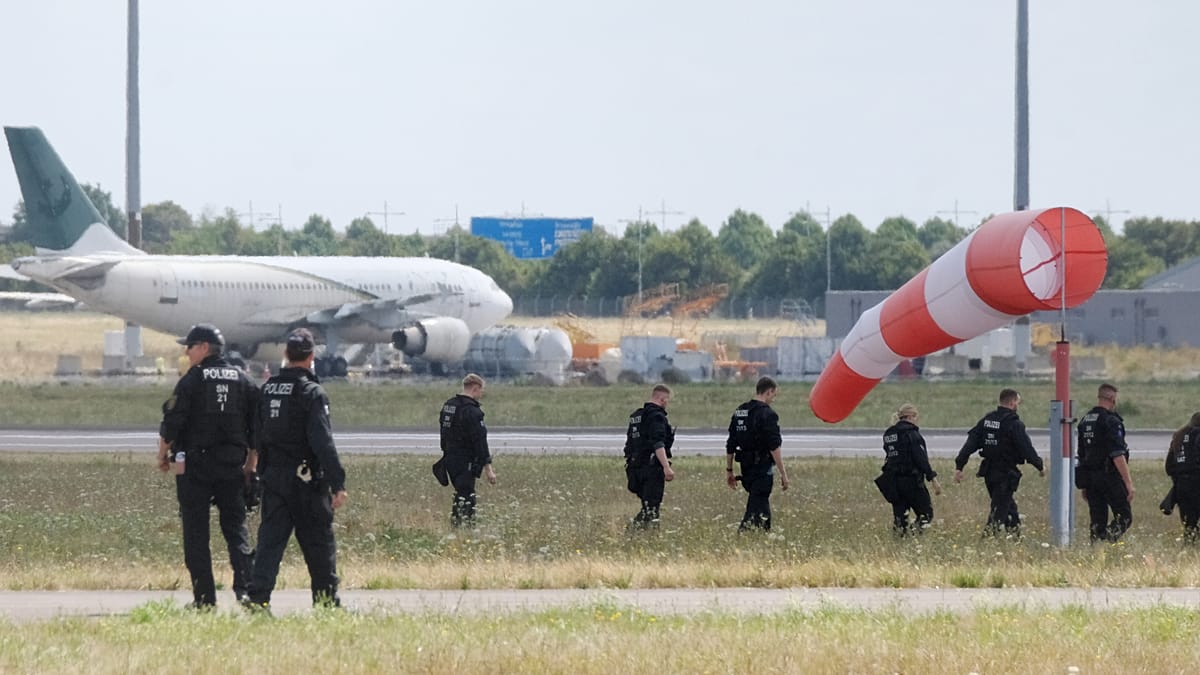
The incident took place on 4 August at Leipzig/Halle Airport. A drone fitted with explosives approached a Ukrainian Antonov transport aircraft. The device was detected and later rendered harmless.
Two other drones are believed, according to current findings, to have failed or been destroyed even before the actual attack: investigators found corresponding debris in the vicinity of the airport.
What makes the attempted attack particularly explosive is the potential blast. According to information from the investigation, a total of around 1.8 kilograms of Semtex was to be used. At the time, the targeted Antonov is said to have been fuelled with around 25,000 litres of kerosene.
In the end, the explosive charge did not detonate, as the detonator apparently became detached, according to current findings. CCTV footage is said to show the drone coming to rest directly next to the aircraft.
DNA trace: possible link to sabotage cases across Europe
The Leipzig case is apparently not being viewed in isolation by European security authorities, Welt reports. Investigators are looking into possible links to other sabotage operations in which drones, explosives or so‑called disposable agents are thought to have been used.
In the investigators’ view, a recurring pattern is that individuals with a criminal background are recruited for specific jobs, while the real masterminds remain in the background.
A DNA trace apparently plays a key role in the search for the suspected perpetrators. Investigators found remnants of a glove on an antenna construction that was presumably used to control a drone.
The traces secured there are said to match DNA data already known from Finland and Lithuania. This brought the Belarusian national Andrei Ka. into the focus of investigators.
Ka. is said to have already come to the attention of the authorities in both countries for ordinary criminal offences; in Finland he is reportedly linked, among other things, to property crimes.
Polish authorities are also said to have mentioned his name in connection with a fire at a DIY store in Łódź. The incident in the summer of 2024 is being investigated there as a possible act of sabotage.
Investigators suspect professional planning
The German authorities apparently assume that the attack was not carried out on the spur of the moment. Hints of multiple drones, possible hiding places for equipment and the use of different launch points all point, in the investigators’ view, to a pre-planned operation.
Ten days after the attack, investigators reportedly came across another drone and a fire site in Kabelsketal, a municipality in Saxony-Anhalt not far from the airport. Specialists are said to have secured around 50 grams of Semtex there. Semtex is a powerful, malleable explosive developed, among other things, for military and industrial blasting operations.
Potential hiding places were also examined south of the airport: near Schkeuditz, investigators are said to have identified several locations where, in their view, material or explosives could have been stored.
The search was driven forward, among other things, by the analysis of a hire car believed to have been used by the suspects.
Russian intelligence service under scrutiny
Particular importance is attached to Oleg Le. According to German security authorities, he is associated with the Russian military intelligence service GRU and is believed to have been responsible for the logistical side of the operation.
Le. is said to have entered Germany via Turkey. He later left the country via Berlin-Brandenburg airport, initially travelling on to Serbia. According to the available information, he is now back in Russia.
In the investigators’ assessment, the German authorities were already aware when he entered the country that he could be linked to the GRU environment. Nevertheless, he was apparently not placed under permanent surveillance.
Political fallout
The dispute has now also had concrete diplomatic repercussions. The federal government has already responded to the allegations and initiated measures against Russia. These include the decision to close the Russian consulate general in Bonn and the Russian House in Berlin. The Russian ambassador was also summoned to the Foreign Office. Further steps, including additional measures at European level, are being examined.
Moscow responded in turn with countermeasures, closing the German consulate general in St Petersburg and also announcing the closure of the Goethe-Institutes in Russia.
The Russian government holds Berlin responsible for the escalation and continues to reject the accusations in connection with the drone attack. From Moscow’s perspective, there is insufficient evidence of direct involvement by Russian state bodies.
For the German security authorities, the priority now is to further substantiate the evidence gathered so far and clearly identify those responsible as well as any possible masterminds. If the suspicion of an operation orchestrated by Russian actors is confirmed, the case could have further consequences for German security policy and its policy towards Russia.
Read the full article here