





1.jpg?prefix=media%2Farticle-covers)
Key takeaways:
- A sharp fifty percent drop in exchange activity and decentralized application revenue is stalling Ether price growth.
- Institutional investor interest in Ether remains under pressure as major holders like Bitmine face billions in unrealized losses.
Ether (ETH) has failed to sustain levels above $2,400 for the past three months, consistently lagging behind most of its peers. Ether’s down 21% in 2026, and investors have expressed uncertainty about the altcoin’s inability to mirror the broader market recovery.
Total crypto market capitalization vs. ETH, USD. Source: TradingView
The total cryptocurrency market capitalization is down 11% year-to-date, suggesting specific headwinds for Ether remain in play. A decline in decentralized applications (DApps) activity partially explains this fading interest. Regardless of whether this trend has affected the industry as a whole, the shift negatively affects ETH price formation.
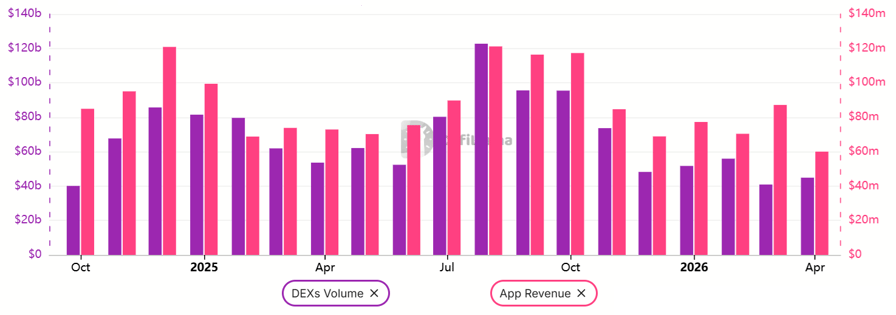

Ethereum DEX monthly volumes vs. DApps revenue, USD. Source: DefiLlama
Decentralized exchanges (DEX) volumes fell by 53% in six months, a sector largely responsible for Ethereum’s DApps activity. Consequently, these DApps experienced a 49% decline in revenue over the same period. While the sharp drop in memecoin prices and token launches contributed to reduced DEX appeal, other factors, including protocol hacks, also played a significant role.
Multiple hacks had a negative impact on DApp activity
The cryptocurrency industry suffered $630 million in hacks in April, with KelpDAO and Drift Protocol accounting for 82% of the losses. Blockchain security company Hacken attributed the attacks to actors linked to the Democratic People’s Republic of Korea (DPRK). Aggregate crypto industry DEX activity dropped by 47% in three months.
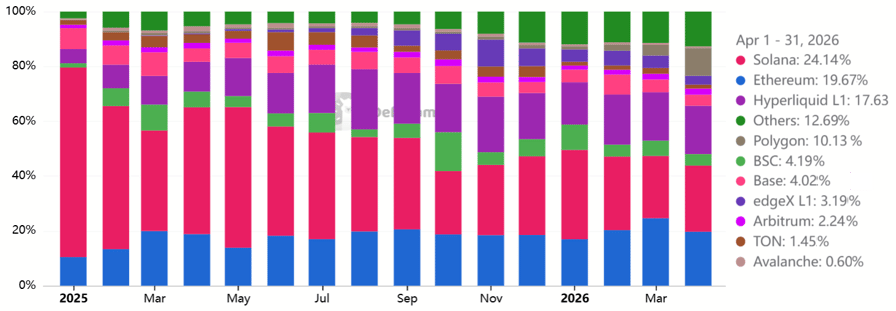

Blockchain DApps revenue market share. Source: DefiLlama
Some Ethereum competitors have opted for base layer scalability, providing less friction for regular users. While Ethereum remains the absolute leader in the aggregate ecosystem, including its layer-2 solutions, Solana and Hyperliquid account for a combined 42% market share in DApp revenue. Such data is even more impressive given that Ethereum’s total value locked is six times larger.
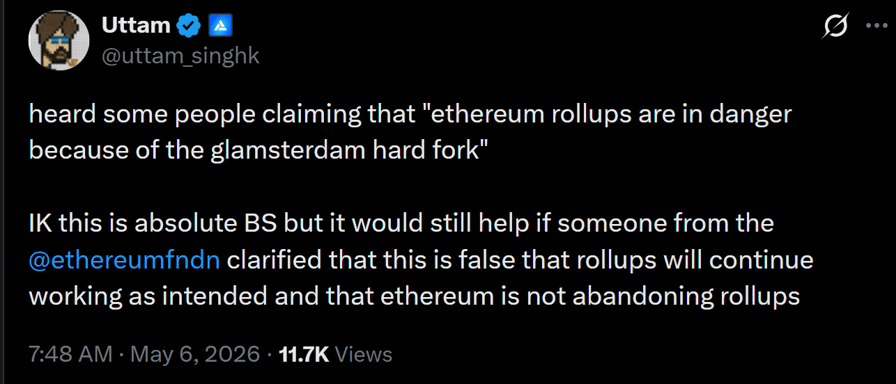

Source: X/uttam_singhk
Uttam Singh, engineer at Alchemy, noted that part of the market incorrectly judged that Ethereum’s upcoming glamstedam hard fork would put rollups “in danger.” The upcoming network upgrade should result in a threefold increase in base-layer capacity and allow clients to pre-fetch block data, thereby enabling parallel transaction execution.
Fierce blockchain competition, ETH whales underwater
Regardless of how straightforward Ethereum’s scaling plans are, most users and investors struggle to understand the need for layer-2 rollups once base-layer scalability reaches a certain threshold. There is also limited visibility on whether these changes will actually generate higher network fees, which ultimately act as a catalyst for higher staking yields.
Related: Ethereum backers pledge up to 30,000 ETH to rsETH recovery after bridge incident
Institutional investors’ perception of Ether has also been negatively impacted as Bitmine (BMNR US), the largest publicly listed holder of ETH, remains underwater in its corporate reserves. The company, led by chairman Tom Lee, spent $12.2 billion to acquire ETH, but its position is currently valued at $10.8 billion. While this does not pose an immediate sell-off risk, it reduces the asset’s institutional appeal.
None of these factors is an absolute impediment for Ether price to reach $2,800. However, declining onchain activity, fierce competition in the DApps industry, and reduced institutional appeal continue to contribute to its underperformance relative to the broader crypto market.
Read the full article here