



Italian police arrested two Pakistani nationals for the murder of four farm workers, three Afghans and one Pakistani, who were found dead in a burnt-out minivan in southern Italy, Italian media reported Tuesday.
ADVERTISEMENT

ADVERTISEMENT
The vehicle was found at a petrol station near the village of Amendolara in a farming area in the Calabria region.
Another Afghan man quoted by Italian media said he survived the killings by smashing a window and running away.
He said the Pakistanis who were arrested had been threatening him and the others with knives and guns and forcing them to work without pay.
CCTV images from the petrol station showed two people blocking the van’s doors from the outside and throwing liquid inside, the Corriere della Sera daily reported, citing law enforcement sources.
The images showed a fire breaking out and the two people running away, the report said.
Firefighters found the bodies inside after putting out the fire.
“This is definitely murder, we just have to work out the details,” local police chief Antonio Borelli was quoted by Corriere as saying.
The paper said there had been 14 cases of arson involving cars and minivans carrying Pakistanis in recent months in the area, where there are tensions between migrants over the division of farm work and residency papers and accommodation.
Condemnation from Meloni
“The horrific murder of the four farmworkers in Calabria has shocked us all. Italy will not back down in the face of violence and barbarity: it is essential to fully shed light on this terrible crime and bring all those responsible to justice,” Prime Minister Giorgia Meloni wrote in a post on X.
The Italian General Confederation of Labour (CGIL), Italy’s biggest trade union, described the killings as an act of “unspeakable horror” and said it would hold a rally on Saturday, starting from the service station where the four farmworkers were killed and continuing with a march to the main square in Amendolara.
Testimony from the sole survivor
Investigators managed to identify the victims thanks to documents found in the flat where they lived with other migrants, including 35‑year‑old Afghan national Mohammad Taj Alamyar, who has been in Italy for about a year and is the sole survivor.
He saw four fellow farmworkers die before his eyes.
Swathed in bandages, he was quick to condemn his tormentors, telling public broadcaster Rai: “It’s the mafia, the mafia…They’re Pakistani mafiosi.”
In halting Italian, the farmworker explained that the two men being held on suspicion of premeditated murder were the ones who wanted money for transport that the victims did not want to pay. When they realised this, the two allegedly first doused the car interior with petrol and then threw in a lighter.
The Afghan man also said that the Pakistani nationals threatened him and the others with knives and guns to force them to work, and that they were not paid: “They didn’t give us any money; they gave us food, yes, housing, yes, but no money.”
He is the only eyewitness to the tragedy and his account tallies with the footage captured by surveillance cameras at the service area. He lived with the men he saw die in a flat in Villapiana. In the accommodation, provided by the Pakistani gangmasters who live in the same town, 10 migrant workers were living together.
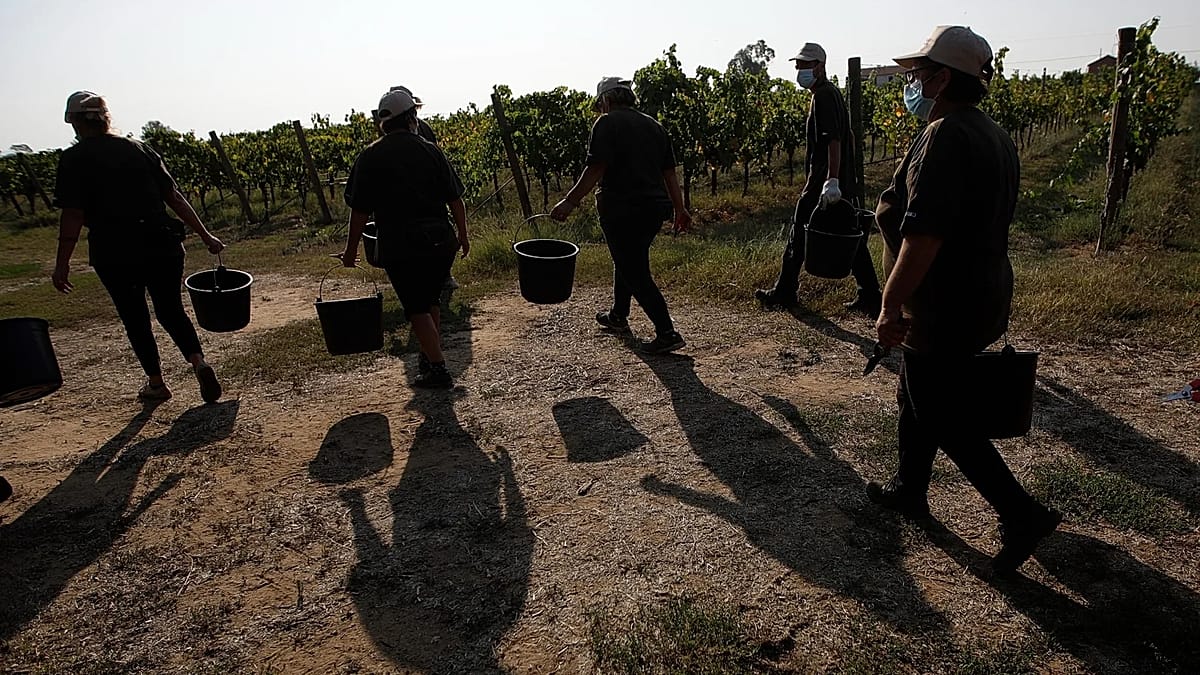
Since 20 April, he and his four “colleagues” had been hired for the strawberry harvest at a farm in Scansano Ionico. Every morning they were taken to work by the same two Pakistani gangmasters. In the first few days they were reportedly paid cash‑in‑hand. Later, they apparently reached an agreement: a daily wage of €45.
“In the end they gave us housing but no pay,” the witness says. “They also demanded €5 a day for the journey to and from work.”
Is the Amendolara case an isolated one?
The most recent agro-mafia and gangmastering report, published in 2022 by the Placido Rizzotto observatory, estimates that around 230,000 people are exploited in Italian fields, a quarter of all agricultural labourers.
For years, the observatory has been studying labour exploitation in agriculture, gangmastering and mafia infiltration, carrying out valuable work collecting reports and complaints.
The study shows that irregular work is particularly widespread in Apulia, Sicily, Campania, Calabria and Lazio, where it is estimated that over 40% of workers have an irregular contract or no contract at all.
In many northern regions, the rate of irregularity is only slightly lower, between 20% and 30%.
Is there a law against gangmastering?
Law 199 against gangmastering was passed by the government in 2016 and is based on two pillars: repression and prevention. Tougher penalties and the introduction of liability not only for the gangmaster but also for the employer have produced some results, but prevention has stalled, both because of the lack of effective inspections and because of migrant workers’ fears.
In order to obtain the documents they need for a residence permit, they accept working conditions akin to slavery, even without being paid, and tend not to report abuses.
The law also makes it possible to place companies under special administration when they are under investigation, and to make them jointly liable, as demonstrated by recent cases in the high‑fashion supply chain and in the construction of the US consulate in Milan.
The number of trials for labour exploitation has undoubtedly increased significantly, but the law is still only unevenly applied, because enforcement depends entirely on investigations by inspectorates attached to the Carabinieri, the financial police, the regular police and the judiciary.
The law provides for a residence permit to be granted to migrants who file a complaint, but the bureaucratic process is lengthy and, in the meantime, migrants are left without protection, without work, without money and without housing, and are therefore exposed to violent reprisals and blackmail by the gangmasters.
Considered a cutting‑edge law across Europe, it has remained largely unenforced. As the Amendolara massacre has highlighted, Italian organised crime has even forged an iron pact with foreign mafias from the very countries where the migrants exploited as slaves come from.
Read the full article here