


By Tatiana Mindekova, Policy Advisor at the global energy think tank ‘Ember’. She holds a Master’s degree in Environment, Politics, and Society from University College London.
Published on
The opinions expressed in this article are those of the author and do not represent in any way the editorial position of Euronews.
The EU is experiencing its second energy crisis in four years. Countries and households are feeling the impact of dependence on fossil fuel imports, as well as exposure to volatile global gas and oil markets.
ADVERTISEMENT

ADVERTISEMENT
Domestic clean electricity can help break this cycle. For instance in Spain, strong growth in renewables weakened the link between gas and power prices, avoiding €10 on monthly power bills for Spanish households during the most recent crisis.
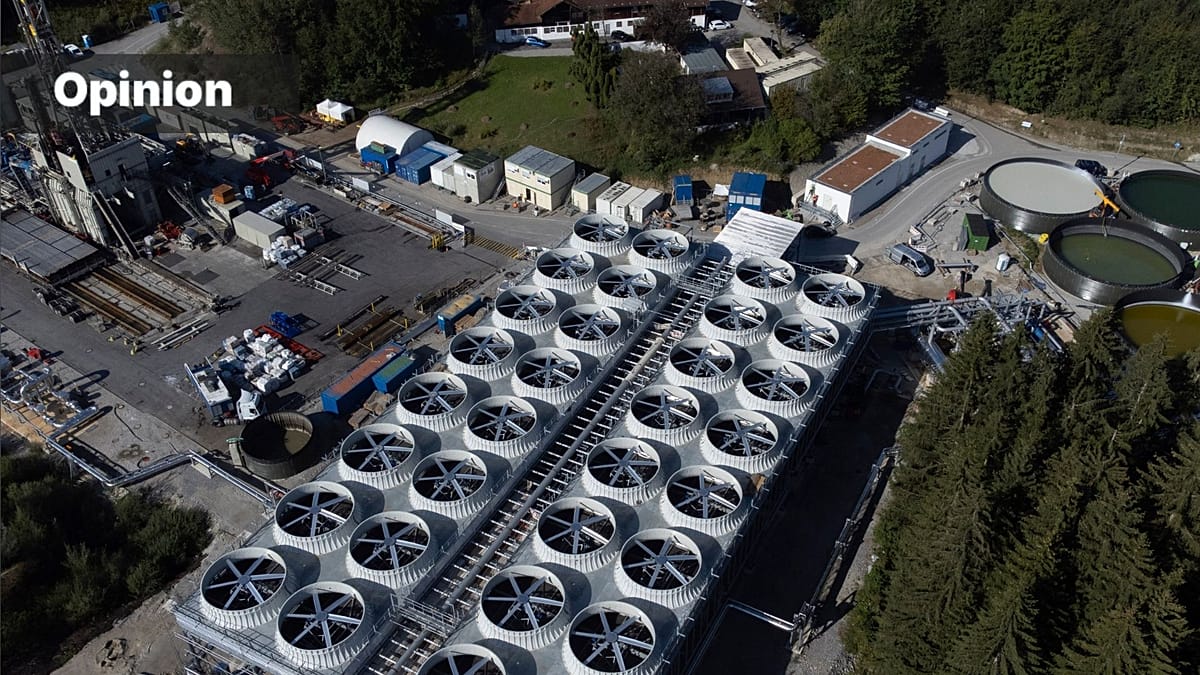
Geothermal is one of the EU’s largest sources of domestic power.
Geothermal is one of the EU’s largest untapped sources of clean, domestic power. The Earth gets hotter the deeper you go, and geothermal simply puts that heat to work: drill down, bring the warmth to the surface, and use it to heat buildings directly or to raise steam that spins a turbine for electricity. For decades this only worked where nature had left hot water or steam close enough to reach. Advances in drilling and a new generation of technology are changing that, significantly expanding the range of geological settings suitable for geothermal power generation.
As a zero-carbon, firm power source, geothermal could complement wind and solar well, providing supply to bridge high-demand periods when renewables produce less. A type of next generation technology, enhanced geothermal systems, could cost-effectively generate around 300 terawatt-hours of electricity a year in the EU, roughly a tenth of today’s demand. And it could do so at below €100 per megawatt-hour, which is competitive with gas- and coal-fired power.
Unlike wind or solar, geothermal developers need to invest millions in exploration drilling before they know exactly what lies underground. Once the resource is confirmed, financing becomes much easier. That gap is where projects stall, and where targeted policies can help.
Where is the Commission’s Geothermal Action Plan?
When the European Commission published its Electrification Action Plan on July 16, it was anticipated that a Geothermal Action Plan would be published at the same time. However, the plan failed to materialise.
The Electrification Action Plan does describe geothermal energy as an “underutilised resource” for clean electricity, heating and cooling. This is a welcome recognition. But the dedicated Geothermal Action Plan, requested by EU Energy Ministers and the European Parliament more than two years ago, has been postponed several times and has now disappeared from the Commission’s agenda altogether.
In North America, next-generation geothermal is no longer a promising technology – it is a business. Fervo Energy, a US company developing enhanced geothermal systems, completed its initial public offering in May this year. Canada’s Eavor Technologies was just ranked second on TIME’s list of the world’s top greentech companies.
Meanwhile, Europe is still discussing how to organise the most basic policy direction to put this technology to use. To catch up to what other countries are already doing, Europe urgently needs a strategy for moving geothermal from political recognition to commercial deployment.
North America de-risks, the EU stalls on domestic support
The United States understood the opportunity of geothermal a decade ago. Through its FORGE programme, the Department of Energy funded demonstration drilling and published the results openly. The Department of Energy then set a target of 60 GW of geothermal capacity by 2050, with costs falling towards $45/MWh.
This approach worked. Public money took on the risk of the first, hardest projects and then withdrew once the technology proved itself, de-risking a new industry rather than subsidising it indefinitely. Fervo Energy, which built on FORGE’s research, is now publicly traded and contracted to supply round-the-clock power to Google’s data centres. Meta, Google and others are following with gigawatt-scale geothermal deals to power AI, turning a technology the state helped de-risk into a market private capital is racing to build.
Canada is following a similar approach. Alberta is building a public drilling test site open to any geothermal company. This month, it awarded Canadian company Eavor a further grant for its closed-loop technology, which avoids the seismicity and groundwater concerns that have historically shadowed geothermal.
Europe funds projects, but not a system. Eavor’s Bavarian plant, Europe’s first commercial closed-loop project, drew €91.6 million from the EU Innovation Fund and more from the European Investment Bank. Cooperation like that is welcome. But one-off grants for flagship projects are not the same as the economy-wide de-risking that both the United States and Canada have built.
Europe still has no systematic way to absorb the cost of exploration drilling, its riskiest phase, so developers fall back on a patchwork of national schemes, and many countries offer none. That gap is why some of Europe’s own start-ups have already relocated abroad to scale faster. The talent and the technology are here; the framework to build a home-grown industry is not.
Geothermal needs strong, clear policy to deliver a home-grown industry
In Germany, Geothermal Energy Acceleration Act has entered into force last year and several countries have adopted national strategies or expanded support schemes. However, EU-level policymaking is needed since shared geological data, common standards and coordinated financing all cut costs across borders.
Europe still has what it takes to keep the geothermal industry at home: drilling expertise from its oil and gas sector, strong engineering firms and existing district heating networks. What it lacks is the coordinated push that would let those strengths scale.
The Geothermal Action Plan is the opportunity to establish the shared risk, common rules and a continental market that will make this technology a success. The plan should focus on the barriers the private sector cannot remove on its own. That means European risk-sharing instruments for exploration, access to innovation funding for drilling, better geological data, and a clear EU-wide deployment ambition to match what the US set in 2019.
The opportunity is clear. The real question is whether Europe wants to become the place where the next generation of geothermal companies is built.
Ember is an energy think tank that aims to drive forward the energy transition through the use of data and policy measures. Before joining Ember, Tatiana Mindekova worked as a project manager at the EUROPEUM Institute for European Policy in Prague. Her work covers a wide range of topics relating to climate protection and decarbonisation, including geothermal energy and the expansion of renewable energy sources.
Read the full article here