




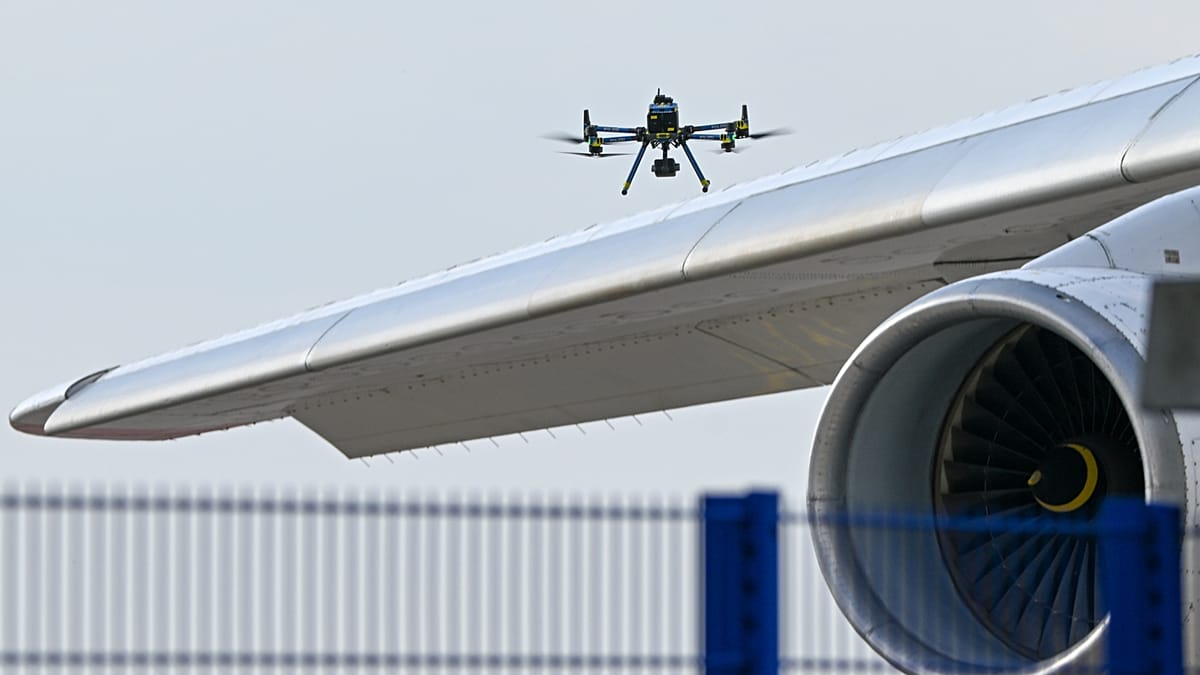
Germany has opened a new drone security research centre as the country steps up efforts to protect airports and critical infrastructure from hostile and unauthorised aircraft.
ADVERTISEMENT


ADVERTISEMENT
Interior Minister Alexander Dobrindt, Research Minister Dorothee Bär and Saxony-Anhalt’s state premier Sven Schulze officially opened the facility on Tuesday in Cochstedt, around 40 kilometres south of the eastern state’s capital Magdeburg.
The Drone Security Technology Centre forms part of the German Aerospace Centre (DLR), which has been operating at the former Cochstedt airport since 2021.
“Together with the DLR we are creating, with the new technology centre, a facility that is unique nationwide, where innovative technologies for drone security are researched, developed and tested in real-life laboratories,” said Dobrindt.
He described the threat posed by drones as part of the “shadow war of the 21st century”.
The new centre builds on the DLR’s existing National Test Centre for Unmanned Aerial Systems at Cochstedt, where researchers test drone technologies in realistic conditions. Drone research is also carried out at a number of other DLR locations across Germany.
The DLR Cochstedt website states: “Within the growing network of future test-field activities, the National Test Centre plays an integrative role as a trailblazer for future research and development of new UAS technologies within the DLR and for external partners.”
Leipzig incident is a warning
Its opening comes amid heightened concern in Germany about the threat posed by drones to airports and other critical infrastructure.
Earlier this month, a drone carrying explosives was found near a runway at Leipzig Airport, around 100 kilometres southeast of Cochstedt. The airport is one of Europe’s largest cargo hubs and is also used for NATO logistics operations.
Germany’s federal prosecutor has opened an investigation into a suspected attack on national security over the incident.
It was later confirmed that a drone equipped with explosives and a detonator had been found near an aircraft belonging to the Ukrainian cargo carrier Antonov Airlines, a NATO spokesperson said.
Dobrindt announced the doubling of the number of posts for drone defence within the federal police.
There are systems in place at German airports and in other sensitive areas to counter unmanned aerial vehicles, but as drone technology is developing at breakneck speed, the defences also have to be constantly adapted.
Following the discovery, defence ministry spokesperson Mitko Müller warned that complete protection against drones was impossible.
“You cannot provide detection and defence capabilities around the clock along tens of thousands of kilometres of fencing. That simply will not work,” he said.
“This deceptive notion of one hundred per cent security, we should not kid ourselves, will not exist.”
Research Minister Dorothee Bär struck a more confident tone on Instagram, pointing to the IDAS-PRO research project, designed to detect, classify and capture unauthorised drones around airports, large events and security zones.
“Unwanted drones over an airport? Over a stadium? Over a concert? Not with us!” she wrote, adding that technological sovereignty also meant using high-tech systems to make Germany safer.
Cochstedt itself has a long aviation history. The site was formerly a Soviet military airfield before eventually being taken over by the DLR and developed as a testing ground for unmanned aircraft and other aviation technologies.
Additional sources • AP
Read the full article here