




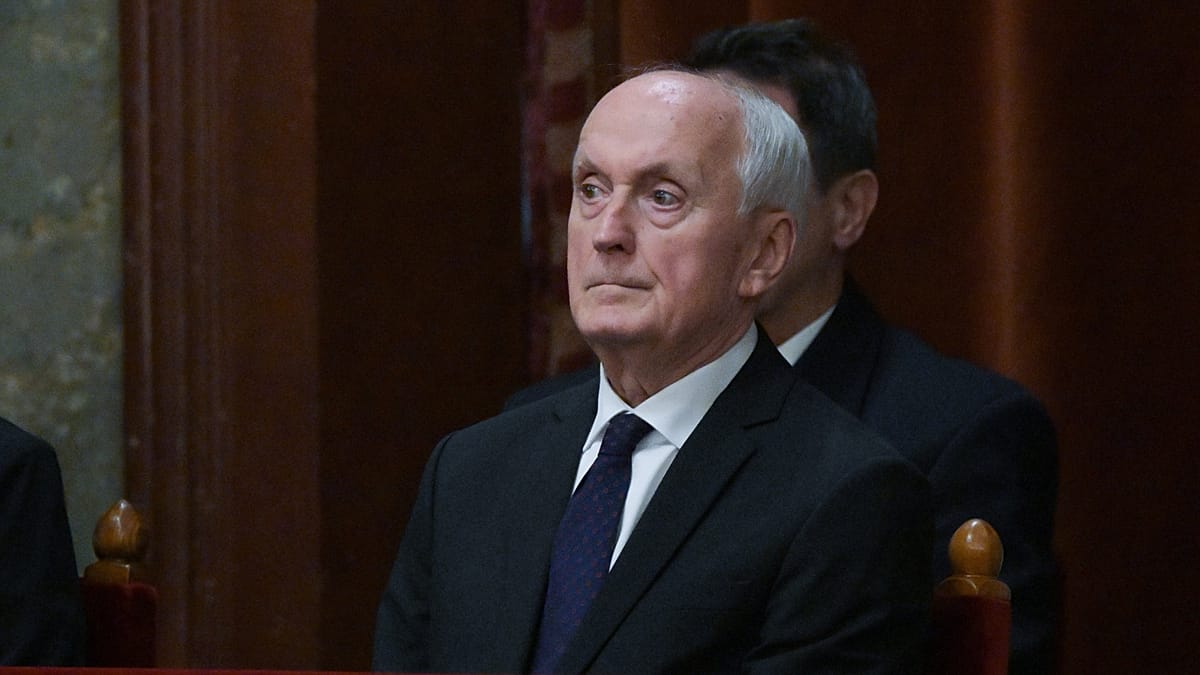
Hungarian lawmakers approved former supreme court chief András Baka as the country’s new president on Tuesday following the contested removal last month of the previous head of state as pro-EU conservative Prime Minister Péter Magyar pushes to loosen his predecessor’s lingering hold over state institutions.
ADVERTISEMENT


ADVERTISEMENT
Parliament, where the ruling Tisza party holds a two-thirds majority, elected Baka, who served 17 years as a judge on the European Court of Human Rights (ECHR), with 140 votes in favour and six votes against.
Tisza nominated 73-year-old Baka for the largely ceremonial role on Saturday.
Magyar said Baka’s life served “as an example of commitment to the democratic rule of law and constitutional principles” as the central European country needs to be “guided back onto the path of the rule of law and constitutional governance.”
‘Captured state’
Hungary’s previous president, Tamás Sulyok, saw his mandate cut short by a constitutional amendment, adopted as part of Magyar’s reform push.
Magyar’s party won elections in April by a landslide, ending nationalist Viktor Orbán’s 16 years in power and promising “system change.”
But rights watchdogs criticised Sulyok’s removal, comparing the tinkering to the methods Orbán used to build his self-styled “illiberal” system.
Orbán’s Fidesz party, along with its ally KDNP, boycotted the parliamentary vote, arguing Sulyok’s ouster was “tyrannical” and “illegitimate.”
Baka has not been critical of Sulyok’s removal, despite the fact he was terminated with a similar legislative act.
“In a country governed by the rule of law, such extraordinary measures cannot be used, but Hungary became a captured state under Orbán,” he told the AFP news agency last month.
State officials like the president “were appointed not to restrain the government’s power, but to ensure the political survival of the former system even after an electoral defeat,” Baka added.
‘Restoration of liberal democracy’
Installing Baka as president signals a “guarantee that the restoration of liberal democracy will proceed along a clearly defined path,” Bulcsu Zsiga, from the Centre for Fair Political Analysis, told AFP.
Besides a brief stint as a lawmaker, elected from the conservative Hungarian Democratic Forum’s (MDF) party list in 1990, after the democratic transition, Baka did not hold any political positions.
He was a judge at the Strasbourg-based European Court of Human Rights (ECHR) from 1991-2008.
In 2009, he was nominated as the head of the Supreme Court, but was ousted in 2012 after he condemned a move under Orbán to reduce the age of mandatory retirement for judges from 70 to 62, calling it a judicial purge.
The European Union and the United States both called the age-limit reduction illegal and in 2016 the ECHR ruled that Baka’s dismissal amounted to a violation of his freedom of expression.
“His nomination also carries a symbolic meaning, given that Baka went all the way to prove that what happened to him was not really in line with European Union norms,” analyst Zsiga said.
Last month, Magyar offered the nomination as president to chess legend Judit Polgar, but she declined after the prime minister faced mounting outrage for not consulting the public as promised.
Magyar has indicated the new president would only serve part of his term, until the completion of a process to replace the Orbán-era Basic Law with a constitution drafted through wide public participation.
Magyar has estimated rewriting the constitution would take one or one and a half years, promising to launch consultations on it next month.
Additional sources • AFP
Read the full article here