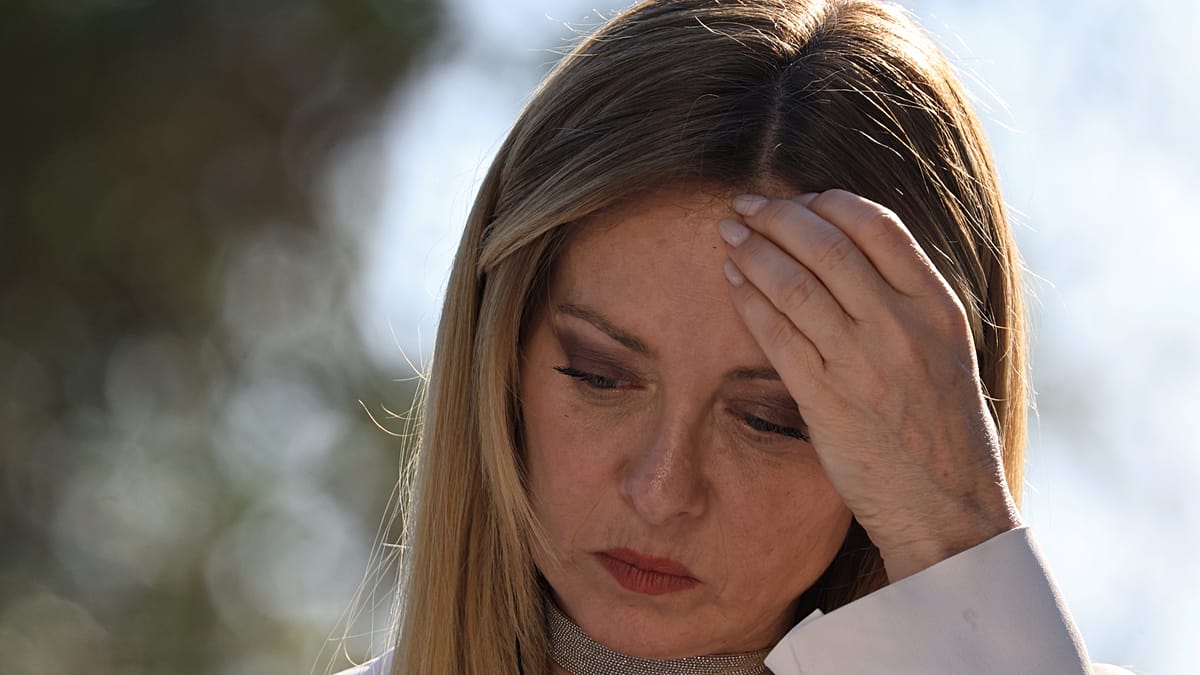



Giorgia Meloni was one of the main political sponsors of a policy of “returns” for irregular migrants. Now, as a growing number of EU countries push Rome to take back migrants who entered the bloc through Italy, she is getting a taste of her own medicine.
ADVERTISEMENT

ADVERTISEMENT
On Sunday, Ireland became the latest in a growing number of member states to call on Italy, as a country of first entry into the EU, to take back asylum seekers.
It joins Germany, Switzerland, Austria, Finland, Sweden and the Netherlands.
The requests stem from the new EU Pact on Asylum and Migration, which reaffirms a key principle of the Dublin system: the EU country where a non-EU national first enters the bloc and applies for protection should handle their asylum claim.
A few weeks after Meloni took office in 2022, Italy unilaterally suspended the reception of Dublin transfers, citing practical and capacity constraints. The European Commission has considered the move a breach of Italy’s Dublin obligations, a position also upheld by the EU Court of Justice in several rulings.
New Pact on Asylum and Migration
Since the Dublin Convention entered into force in 1997, some European governments have tried to scrap this principle, arguing it overwhelms countries geographically exposed to first entry, such as Spain, France, Italy, Greece and, more recently, Cyprus.
After failing to reform the EU asylum system in the 2014-2019 legislature, EU lawmakers succeeded in the next one, delivering a new asylum and border management system — the EU Migration and Asylum Pact — which entered into force in June 2026.
The pact reaffirms the return principle, requiring asylum seekers who move onward to be transferred back to their EU country of first entry, which makes secondary movements from Italy to another EU country far more complicated.
In particular, the new Pact modified the Dublin rules by replacing the previous ‘take-back request’ procedure for secondary movements with a simpler notification mechanism. This removes the need for the responsible member state to formally accept a take-back request, which Italy virtually never did.
At the same time, the pact foresees a mandatory solidarity system among the EU countries, but the annual number of relocations remains too low to deliver any meaningful redistribution.
In 2026, only 8,878 migrant people will be relocated from countries considered “under migratory pressure”, Italy, Spain, Greece, Cyprus and Malta, to other EU member states. Last year, over 66,000 irregular migrants arrived in Italy by sea and Frontex recorded almost 178,000 irregular crossings into the EU.
Despite the low numbers of intra-EU relocations, the Italian government has supported the new rules on migration. “The new agreement marks a positive turning point for Italy in the management of so-called ‘Dublin’ migrants,” Meloni wrote in a Facebook post, replying to domestic critics.
“The new rules provide much greater protection for countries of first entry with regard to asylum claims and, with the strengthening of the ‘safe third country’ principle advocated by Italy, it will be easier to carry out accelerated returns,” she added.
Returns, but where?
A key part of the EU migration package is the Return Regulation, finalised last June.
The mechanism aims to increase the number of rejected asylum seekers, as too few people whose applications are refused are actually sent back to their countries of origin.
EU governments have also pursued other ways to speed up returns, notably the creation of “return hubs” in non-EU countries. These would allow member states to send migrants to a country with which they have no direct or indirect connection.
But returning a migrant to their country of origin — or to a third country — requires a bilateral agreement. Italy has spearheaded this approach with a return hub in Albania, although Italian judges have repeatedly ruled against the scheme.
Germany, Austria, Greece, the Netherlands and Denmark are jointly working to establish return hubs outside the EU. The Greek daily Kathimerini reported earlier this month that negotiations for a facility in Uganda were at an advanced stage, with the aim of making it operational in 2027.
Still, the legal and practical hurdles involved in setting up return hubs in third countries mean they are unlikely to provide an immediate response to irregular arrivals. For now, that makes it easier for EU countries to return migrants within the bloc to their country of first arrival under the Dublin principle.
Ironically, the only two countries that have explicitly ruled out Dublin-based returns to Italy are Spain and France — the same two member states that have dismissed Meloni’s return hubs as “ineffective” and opposed funding them with EU money.
“Meloni has fully endorsed the New Migration Pact, opting for political instrumentalisation that boasted Italy as leading the way in EU migration policy,” Sara Prestianni, advocacy director at the NGO Euromed Rights, told Euronews.
“The Italian government did not properly fight Dublin’s first-arrival principle, which makes little sense since it leaves migrants who want to reach a different destination country in a legal limbo for months or even years,” Prestianni said.
Old fault lines resurface
Returns are now dominating Europe’s migration debate, as most EU countries, regardless of political colour, push for a harder line, a shift sharpened further by the crisis in the Spanish exclave of Ceuta.
The Ceuta crisis triggered a major diplomatic rift between Rome and Madrid, after Meloni broke with the usual solidarity between frontline member states to suspend Schengen free-movement rules and reinstate border checks with Spain.
Now, the heating up of Dublin-based returns is reigniting a more traditional cleavage between frontier member states and countries of destination, a friction that has become particularly visible between Italy and Germany.
“If Italy maintains this stance, it will destroy the new European asylum system, which has only been in effect for a few weeks,” Alexander Throm, the CDU/CSU parliamentary group’s spokesperson on interior policy, told the German news agency DPA.
Meanwhile, Italian Interior Minister Matteo Piantedosi has announced he will host a meeting with his counterparts from the MED5 countries — Cyprus, Greece, Italy, Malta and Spain — to address the situation.
The Italian government considers the issue to be strictly intertwined with the activity of German-based non-governmental organisations rescuing people at sea, which it claims are a “pull factor” to attract irregular migrants.
Nicola Procaccini, a senior MEP from the ruling party Brothers of Italy, told Euronews Italy will take back the “Dublin” migrants when the new EU rules are fully in place, but doubled down on the request to Germany to crack down on the NGOs.
“In the past, these organisations, financed by previous German governments, brought large numbers of migrants to Italy. So a certain degree of irritation is legitimate, as Germany has not picked up the bill for this,” Procaccini said.
Migration has become a central campaign issue as several EU countries head to the polls next year, including Italy, France and Spain, with radical-right parties continuing their projected growth and eroding the political centre.
In Italy, Meloni faces competition from a new hard-right party led by MEP Roberto Vannacci, while in Germany the coalition government is under pressure as the far-right Alternative for Germany, projected as the country’s leading party, could win an outright majority to govern Saxony-Anhalt alone next month.
Read the full article here