


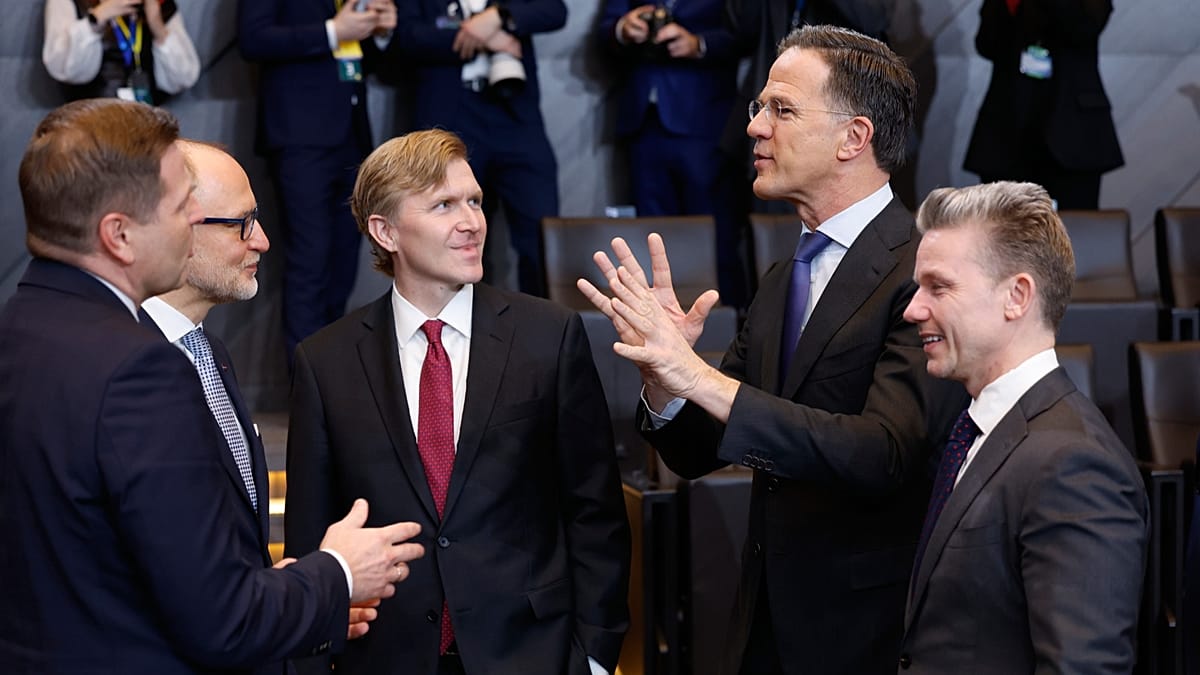
NATO defence ministers meeting on Thursday were keen to stress that support for Ukraine remains top of their agenda following weeks of debate over security in the Arctic that culminated with the launch of a new alliance activity in the High North.
ADVERTISEMENT

ADVERTISEMENT
At Thursday’s defence ministerial in Brussels, the alliance ministers broadly lauded the launch of the Arctic Sentry enhanced vigilance activity – announced the day before by Secretary General Mark Rutte – to boost NATO’s presence in the High North.
The new multi-domain activity will bring together the activities of the 32 allies in the region under one overarching operational strategy. This will include Denmark’s Arctic Endurance, a series of multi-domain exercises designed to enhance the allies’ ability to operate in the region, and Norway’s upcoming exercise Cold Response, where troops from across the alliance have already begun to arrive.
This had been a key demand from US President Donald Trump, whose threats to forcefully take over Greenland, a semi-autonomous territory belonging to NATO ally Denmark, had put the very existence of the 70-year-old alliance in danger.
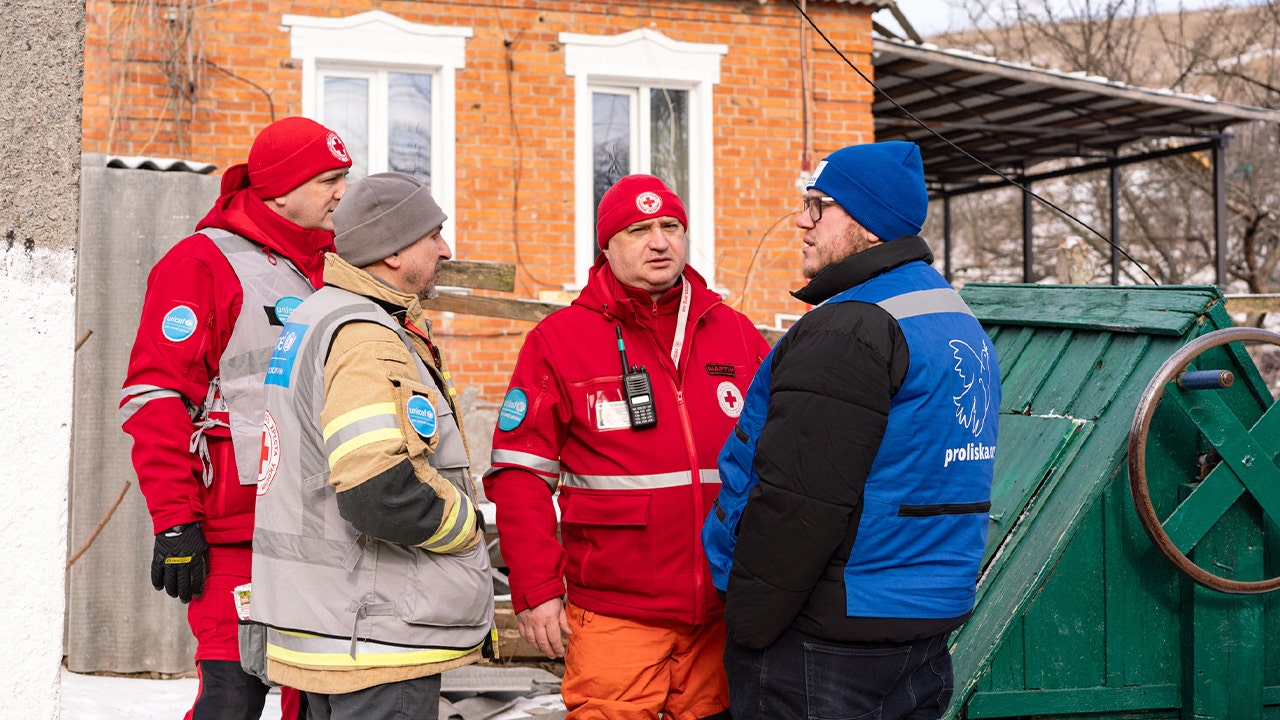
But they were also at pains to stress that Ukraine, whose civilian infrastructure has come under heavy Russian shelling in recent months depriving many of electricity and heating amid sub-zero temperatures,firmly remains their number one priority.
Defending the eastern flank
Þorgerður Katrín Gunnarsdóttir, the defence minister of Iceland, warned against any drift in focus.
“We cannot allow us to have lesser focus on the eastern flank,” she told reporters upon arriving at NATO headquarters, describing Ukraine as fighting “for Europe’s freedom and sovereignty.”
For Reykjavik, Arctic Sentry and support for Kyiv are not competing priorities but parallel responsibilities, with a “just and lasting peace” in Ukraine central to European security.
Similarly, Antti Häkkänen, the defence minister of Finland, another Arctic country, called for Western allies to double down on their pressure on Russia, both economic and military.
“Now is the crucial time to keep on supporting Ukraine even more and show (Russian President Vladimir) Putin that the West is not dropping back,” he said.
The minister from Estonia, one of NATO’s most vocal hawks on Russia, welcomed the launch of Arctic Sentry but insisted it “doesn’t take away the focus from Ukraine, from the eastern flank.”
Hanno Pevkur, echoing the sentiment of his Finnish counterpart, also called for more pressure on Moscow, saying that “it’s not only the battlefield where Russia needs to be pressured. It’s also the economy, it’s also society”.
New support packages
German Defence Minister Boris Pistorius argued that while NATO must “orient our radar systems in all directions” as Russia seeks confrontation “in many parts of the world,” including the Arctic, “the focus will of course remain on NATO’s eastern flank”.
Pistorius described Russia’s ongoing strikes in Ukraine as “terrorism against the civilian population” and called for an urgent ramp-up in support.
The day before, while attending a meeting of European Union defence ministers, Pistorius said that Berlin would likely make further use of the Prioritised Ukraine Requirements List (PURL) to finance air defence for Ukraine.
Under the PURL, European allies buy US-made weapons for Ukraine. The instrument was launched last summer after Washington ceased all direct US donations to Ukraine.
Sweden also said that it will be assembling a third PURL package, with the details to be unveiled later on Thursday following a meeting of the Ukraine Defence Contact Group (UDCG). It contributed over $325 million (€273.5 million) in its first two packages.
The UK, which co-chairs the 50-nation-strong UDCG meeting, announced on Thursday that it would boost support to Ukraine by a further £500 million (€574 million), with £150 million (€172 million) to go through PURL to pay for US air defence interceptors. The remaining money will fund 1,000 UK-manufactured lightweight multirole missiles.
Rutte, meanwhile, sought to reconcile the alliance’s widening aperture with its enduring commitments, arguing that “NATO is so strong that we can do both”.
“We have to make sure that we defend every inch of our territory,” Rutte said, highlighting that many allies are Arctic countries – the US among them.
Elbridge Colby, the US Under Secretary of War, who is attending the NATO meeting in Brussels in lieu of Secretary of Defence Pete Hegseth, did not mention Ukraine or the eastern flank in his short address to the media.
Read the full article here