




Since the start of Russia’s full-scale invasion of Ukraine in February 2022, Ukrainian President Volodymyr Zelenskyy has repeatedly appealed to Kyiv’s Western allies for additional air defence systems.
ADVERTISEMENT


ADVERTISEMENT
According to publicly available information, Ukraine has so far been promised or supplied with around eight Patriot air defence systems. Germany has provided three of these from Bundeswehr stocks and has pledged two more.
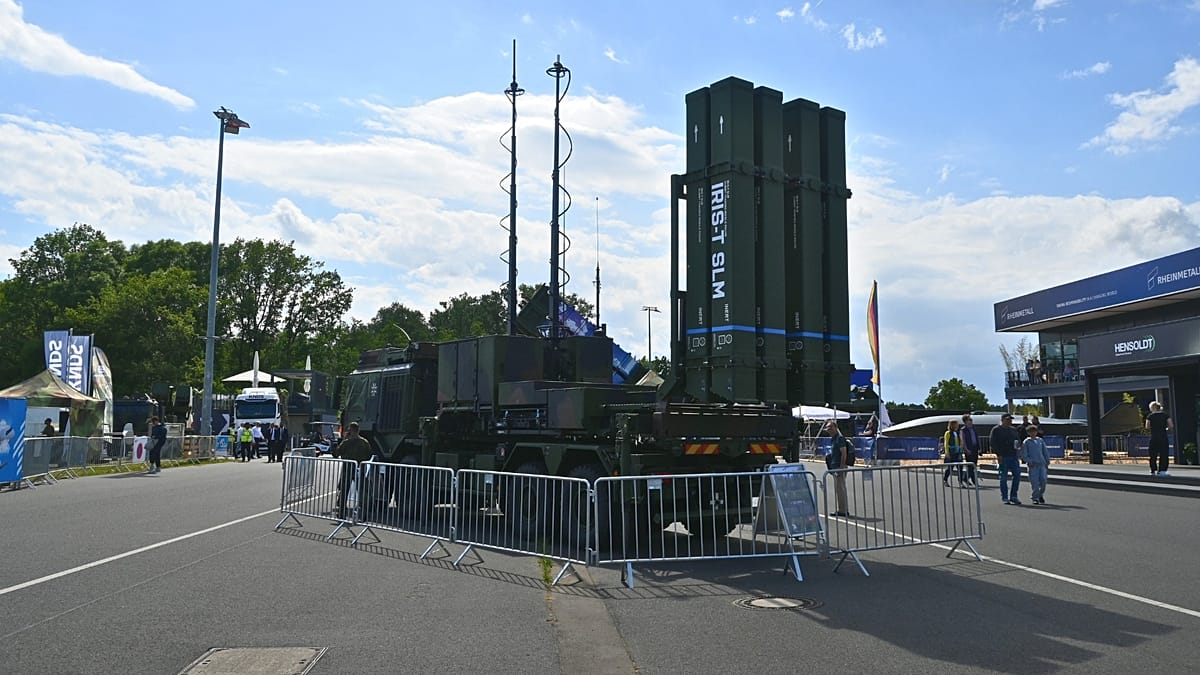
Alongside the US-made Patriot system, the German government has also delivered six IRIS-T SLM medium-range air defence systems and six IRIS-T SLS short-range systems to Ukraine. Both are manufactured by German defence company Diehl Defence, which is based in Überlingen on Lake Constance. Unlike the Patriot system, the IRIS-T SLM features a rotating radar, Staff Sergeant Thomas explained to Euronews at this year’s International Aerospace Exhibition (ILA).
Thomas, who has worked in maintenance for the system and has served in the Bundeswehr since 2020, said the IRIS-T SLM’s 360-degree radar allows it to detect targets approaching from any direction.
“Because the launch canisters are positioned vertically, we can also provide air defence coverage in every direction. It doesn’t matter whether a target approaches from the front, the rear, the left or the right,” Thomas said.
The launch canisters of the IRIS-T SLM are the large upright containers that house and fire the missiles. By contrast, the Patriot system’s radar and launchers are oriented towards the anticipated direction of the main threat, on the assumption that incoming targets are most likely to approach from that sector.
A complete IRIS-T SLM battery consists of a radar unit, a command-and-control centre and three launchers. Despite the system’s sophisticated capabilities, operating it is relatively straightforward, according to Staff Sergeant Thomas.
“In practice, there are only a few buttons to press and a handful of prompts to confirm. The system guides you through the set-up process and much of it happens automatically,” he said.
Could IRIS-T SLM become Europe’s answer to Patriot shortages?
Russia’s war against Ukraine and the recent US-Israeli conflict with Iran have significantly increased demand for Patriot air defence systems and interceptor missiles. In early June, The Guardian reported a global shortage of Patriot interceptors, warning that the shortfall had already created vulnerabilities in Ukraine’s air defences.
Last week, the Financial Times reported that demand for Patriot PAC-3 interceptor missiles had surged as a result of the conflict with Iran and that manufacturer Lockheed Martin was currently unable to provide allies with reliable delivery timelines. According to Reuters, both the Pentagon and the White House have pressed the defence industry to ramp up production, as continued support for Ukraine and military operations in the Middle East place growing strain on existing stockpiles.
Since the IRIS-T system is manufactured in Germany, the question arises whether it could serve as an alternative to the Patriot system. Staff Sergeant Thomas, however, does not see the German-made system as a replacement. “It’s not better – it serves a different purpose,” he explained.
The Patriot’s main advantages lie in its greater range and its ability to intercept ballistic missiles. While the IRIS-T SLM can engage targets at distances of up to 40 kilometres, the Patriot system can reach significantly farther, depending on the interceptor missile being used. These include the PAC-2 GEM-T, which is primarily designed to counter aircraft and cruise missiles, as well as the more advanced PAC-3 and PAC-3 MSE interceptors, which are optimised for defending against ballistic missile threats.
“Because Patriots can engage targets at much greater distances, there is also a lower risk of debris falling into populated areas,” Thomas added.
Beyond air defence: Germany’s long-range gap
While Germany is investing heavily in rearming its armed forces, one critical capability remains absent from the Bundeswehr’s arsenal: so-called deep-strike capabilities. The term refers to the ability to carry out precision strikes against high-value military and infrastructure targets hundreds or even thousands of kilometres behind the front line.
To address this shortfall, former Chancellor Olaf Scholz and then US President Joe Biden agreed that the United States would deploy Tomahawk cruise missiles to Germany from 2026 onwards as part of NATO’s deterrence posture towards Russia. However, recent reports suggest that the deployment may no longer go ahead.
According to reports published in early June, the planned deployment has reportedly been shelved. Politico, citing European and US officials, reported that members of the Trump administration were concerned Russia could view the move as escalatory and respond accordingly. For Germany, the cancellation would remove a key element of a planned enhancement to its deterrence and defence capabilities.
Against this backdrop, German defence manufacturer Diehl Defence announced an expansion of its cooperation with Ukrainian arms company Fire Point during an interview with the Financial Times at the ILA air show. Fire Point produces the Flamingo cruise missile, a Ukrainian-developed long-range weapon with a reported range of up to 3,000 kilometres.
According to Ukrainian officials, the FP-5 Flamingo has already been used in strikes against targets deep inside Russian territory. Among them was a military facility in the city of Izhevsk, which is believed to supply Russian forces with components for drones and missiles.
Located roughly 1,300 kilometres from the Ukrainian border, Izhevsk is among the most distant targets reached by Ukrainian weapons systems since the start of the war.
The two companies are now exploring the possibility of producing the FP-5 Flamingo cruise missile in Germany. Helmut Rauch, Chief Executive of Diehl Defence, expressed optimism about the partnership, with further discussions expected to take place in the coming weeks.
Read the full article here