


On the day of the 250th anniversary of the United States, Pope Leo XIV chose to visit Lampedusa, the island that has become a symbol of the migrant emergency in Italy and across Europe. The last time a pope visited Lampedusa was in 2013, when Pope Francis chose the island for his first apostolic journey, signalling from the very start of his pontificate his commitment to the migrant cause.
ADVERTISEMENT


ADVERTISEMENT
Immediately after landing, the pope headed to the Cemetery of the Nameless in Cala Pisana to pay tribute and pray at the graves of migrants who died at sea. The graves are marked with crosses made from the wood of boats that sank off the island’s coast.
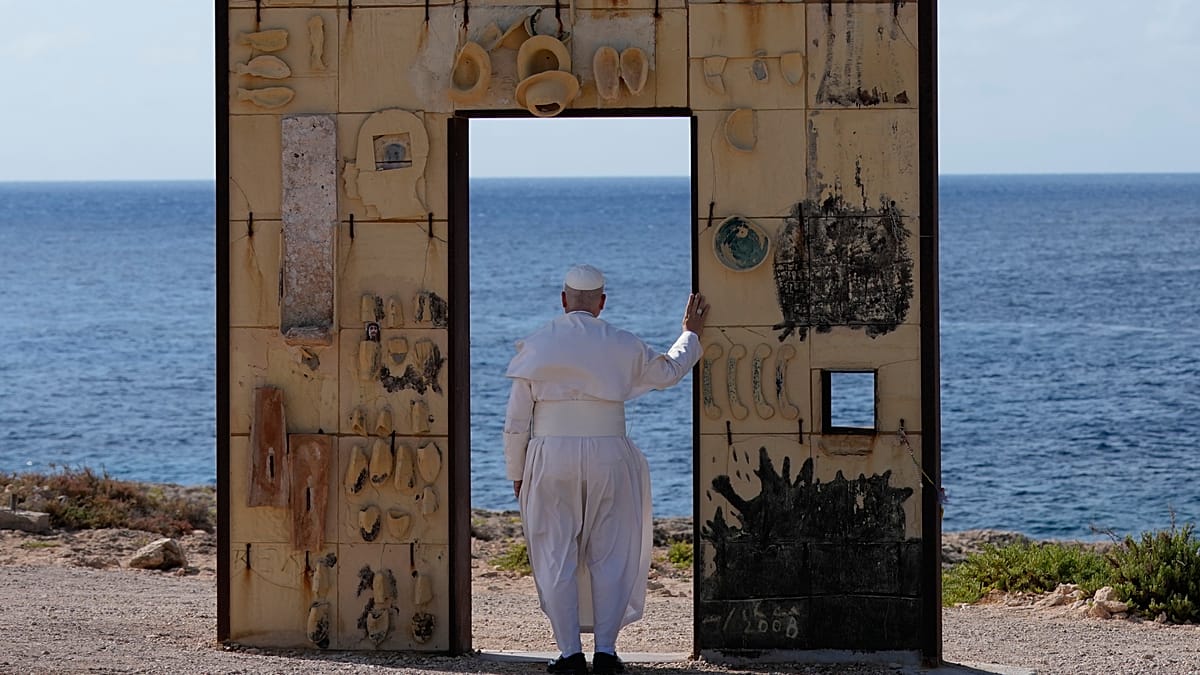
Pope Leo XIV then made his way to the Porta d’Europa, the symbolic ceramic-and-iron sculpture overlooking the Mediterranean. There, he met a migrant family, then walked through the arch, resting his hand on its right-hand side. The strong wind blew Leo’s skullcap off, and he then stood for a long time gazing out to sea, with a navy ship patrolling the waters off Lampedusa visible on the horizon.
The Pope also received a letter from a child migrant. “Dear Pope, I’m super excited to meet you! Ten years ago my story began here in Lampedusa. I was alone and had lost everything, especially my mum. They tell me I only stopped crying when they gave me a ball made out of paper; from that day the ball has stayed in my heart and I haven’t stopped playing. I really hope that this ball I’m giving you now can reach another child and make them happy just like me. Thank you, Leo,” the boy wrote, handing the Pope a football as well.
Pope Leo XIV blesses plaque dedicated to Pope Francis
The pontiff’s visit then moved on to Molo Favarolo, another symbolic site on the island where migrant boats are brought ashore. He unveiled and blessed a plaque dedicated to Pope Francis: from now on, the quay will be known as Molo Francesco.
The Pope met and shook hands with 15 migrants brought from the Contrada Imbriacola hotspot run by the Red Cross, which currently houses 138 people, including 51 unaccompanied minors. The most recent landing on the island was on Friday evening, when the coastguard rescued 17 people on board a small boat, among them five women and three children.
“By deciding to name Molo Favaloro after Pope Francis you are giving a sign of the bond my predecessor forged with your community and with migrant brothers and sisters: the Pope has stood by you in these very demanding times. And today I am here to tell you that the Pope continues to walk alongside you, to support you and encourage you,” Pope Leo XIV wrote in a letter sent to the mayor of Lampedusa on the occasion of his visit.
“I have not come here to give speeches, but to celebrate the Eucharist, the supreme sign of Christ’s presence among us. The act of Jesus breaking the bread and giving himself lends meaning and strength to our daily gestures of care and sharing. Yes, this is a place where gestures speak louder than words. But for gestures to be truly human, they need a heart. That is why we have gathered here: to draw from Christ the love that only he can give us, so that today’s world, and tomorrow’s, may be more human, more human for everyone,” the pope went on in his letter.
The Pope urges Europe to confront the migrant crisis
Before the Mass held at the ‘Arena’ sports ground, the Pope travelled through the streets of Lampedusa in a giardinetta, a typical local car lent by an islander for the special occasion, greeting the crowds and stopping to bless children. Authorities said around four thousand people gathered at the ground to take part in the celebration led by the pontiff.
“I have come to thank you for the closeness so many of you have shown; once again the miracle of compassion has taken place. From this far-flung edge of Europe in the Mediterranean, the historic challenge that migration poses to European societies is all the clearer. Europe has a unique potential, rooted in its history and its culture, and with it an equal measure of responsibility,” the pope said.
“Because of its geographical position and institutional set-up, Europe is able – in this region – to tackle the crisis in a coherent way, embedding first response within a long-term strategic plan capable of welcoming, protecting, promoting and integrating migrants and, at the same time, working for development, so that no one is forced to emigrate. All this must be done while ensuring respect for the dignity of every person. This is a task for public institutions, but also for the whole of civil society and for the Church,” he added, calling on Europe to live up to its responsibilities in welcoming migrants.
The pope then pointed out that Lampedusa is an island that receives not only migrants but also holidaymakers. As he said recently in Tenerife, during his apostolic journey to Spain, he recalled that people must not feel threatened by migration routes or lapse into indifference.
“It is as if an invisible wall had to be raised between the sea of shipwrecked people and the sea of holidaymakers. Have the courage to think differently. Little by little, with creativity, you will succeed in ensuring that anyone who spends time on this island, even on holiday, can become more human by being confronted with your charity, with what the sea has taught you, with the encounters that have shaped you,” the pope said.
Criticising those who ignore the migrant crisis, the pope then turned his focus on indifference and corruption. “Love always lives in freedom, and freedom lies in our decisions. There are those who choose not to draw near, and those who choose not to choose. The dead in this sea are victims both of decisions taken and of decisions not taken. Indifference to the common good and corruption in countries of origin, a global economic system that generates poverty and exclusion, the fear that feeds prejudice and contempt, the idea that these problems have nothing to do with us, the criminal calculations of those who profit from other people’s suffering, the slow and difficult shift from merely managing emergencies to drawing up coherent, shared policies: all this today mirrors, in the Gospel account, the haste to ‘pass by on the other side”, he said.
“Let us not be overcome by fear, but look at daily struggles as a time of opportunity and witness. May the venerated image of Our Lady of Porto Salvo once again speak to you with the same power as in the past, when those who handed this devotion down to you told you that we all have in God a safe harbour, and that every Christian community is called to be a reflection of it on earth. And to you, communities of Lampedusa and Linosa, may you never lack the breath of faith, hope and charity: “O’scià!”, the Pope concluded, using the local Lampedusan greeting, which translates to “my breath”.
Read the full article here