
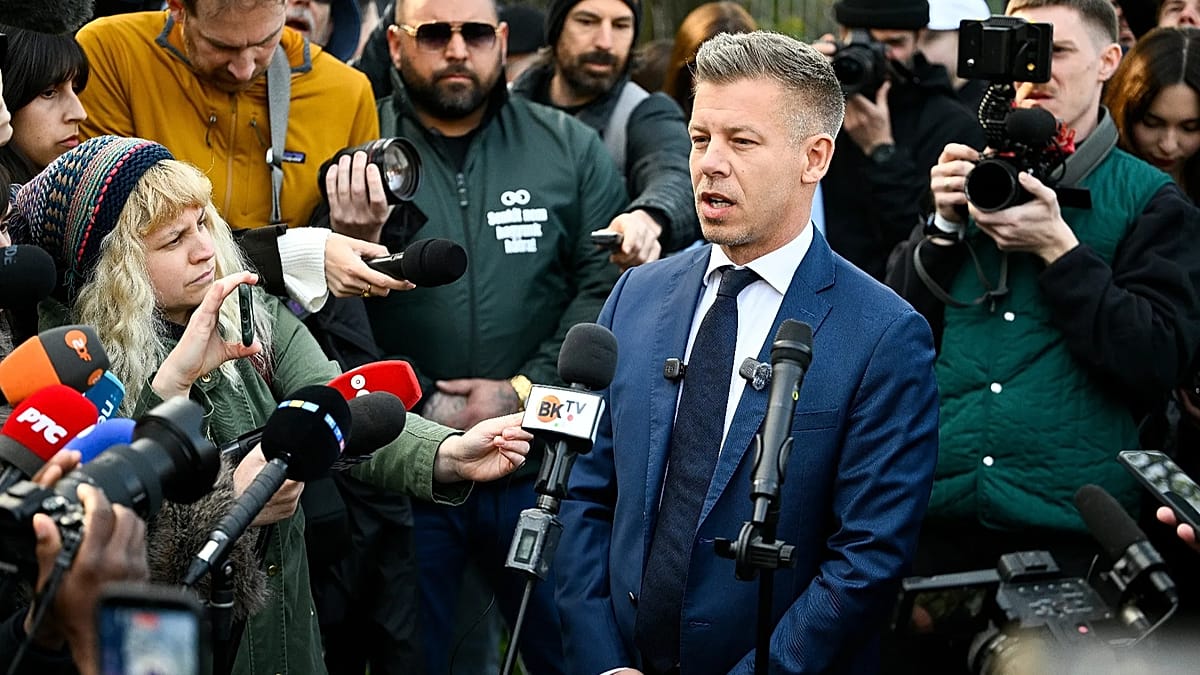



HEX erases $246 million in market cap after founder detained in Turkey
The HEX market cap fell from $561 million to $315 million this week after founder Richard Schueler — better known to the crypto community as Richard Heart — was detained by authorities in Istanbul on October 14.
Police seized $7.15 million in cash along with firearms and ammunition during an early morning raid in Istanbul’s Beşiktaş district, alongside searches of 15 related addresses according to Turkish Justice Minister Akın Gürlek.
Police impounded nine luxury vehicles registered to Schueler’s wife according to news agency Anadolu. The haul reportedly included 28 watches, 300 bags and 19 graphics cards.
Interpol issued a “Red Notice” for Schueler’s two years ago over allegations of tax fraud and assault, after Finnish authorities sought his arrest.
A spokesperson for Finland’s National Bureau of Investigations declined to comment on the matter.
Turkish media refer to Schueler as “Whale James” and have linked him to a $1 billion unregistered securities offering in the US. However that case was dismissed by a US judge in February 2025.
Images circulating in Turkish media appear to show a surprised Heart with no trousers on, and the bottom half of his body blurred out, provoking much merriment on social media. Vocal Hex critic Eric Wall, who has debated Schueler on video and social media, said he initially thought the image was AI generated but now believes it is real:
“i’m pretty much certain i died in a plane crash in 2015 and ever since that day i am still only alive in a fringe reality where everything is designed to be as funny as possible.”
Hex supporters claim that authorities are yet to confirm if Schueler has been formally arrested or charged.
Images circulating on Turkish media.
Ledger’s answer to wallet tampering costs $849 and ships next year
Ledger unveiled a new device on Thursday with stronger protections against tampering, days after confirming that wallets sold through a reseller in Asia contained malicious implants.
The French hardware wallet maker introduced Atom, an $849 device that combines a crypto wallet with everyday apps through a smartphone-like design. Atom separates Android apps from sensitive wallet operations and includes protections Ledger says would block the implants used in the recent Asia incident. It claims to detect tampering even when switched off.
Expected to become available in summer 2027, Atom will also support AI agent approvals, encrypted messaging and post-quantum cryptography.
Meanwhile a war of words has broken out between former Mt Gox CEO Mark Karpeles, and Ledger CEO Pascal Gauthier. Kapeles claims that at least two people notified Leger of spyware discovered inside tampered Ledgers as far back as December 2025 — and notes the company had even written about the issue on its website in March 2026. He says the company failed to act properly to secure its reseller supply chains, which have now been suspended across Asia after more than $90 million was stolen.
Gauthier snarkily replied on X that Karpeles was “no white knight” and referred back to his failures in the lead up to the Mt Gox hack.
Karpeles replied:
“I was hoping you guys were better than that. I’ve been holding Ledger at a higher standard than what happened at MtGox, because I trusted you to do better by learning of my failure — to be better than me.”


QDay gets even closer as Starknet votes on becoming post quantum L1
Google has demonstrated a new process called “magic state cultivation” on its Willow quantum processor that reduces errors 40-fold. The technique achieved a record 99.99% accuracy rate for a specialized quantum state required to perform advanced calculations.
Meanwhile Theta Labs has posted three news quantum circuits that could reduce the number of qubits required to break elliptic curve cryptography by 28% from Google’s current estimate of 1,175 logical qubits.
With fears that AI is now getting so good at math that it may be able to break elliptic curve cryptography even before QDay arrives, Starknet has opened a vote to transform itself from an Ethereum L2 into a post quantum L1. StarkWare CEO Eli Ben-Sasson says that Ethereum’s post quantum roadmap may be too slow to meet the challenge from AI, meaning that Starknet needed to consider becoming a fully post quantum L1.
“Quantum-proofing crypto is urgent, so we must move at lightning speed,” he told Cointelegraph. More than 99% of votes cast to date are in favor of the move. Starknet’s token has lost almost 50% in value this week, after a big surge last week.
Standard Chartered pushes $2T stablecoin forecast to 2030 as EU embraces USDC
Standard Chartered says stablecoin transaction activity continues to grow even as the market’s overall value has stalled, suggesting existing stablecoins are circulating more frequently rather than new supply driving growth.
The bank said it now expects stablecoin market capitalization to reach $2 trillion by 2030, two years later than initially projected, after the market plateaued at roughly $309 billion this year.
Meanwhile the European Banking Authority has classified Circle’s USDC stablecoin as a significant e-money token under the region’s Markets in Crypto Assets (MiCA) framework. The classification has only been granted to 45 projects.
Binance.US seeks $1B valuation in potential $100M funding round
Binance.US reportedly seeks to raise up to $100 million in a funding round that could value the cryptocurrency exchange at $1 billion.
According to a Thursday Bloomberg report, the US-based crypto exchange is pursuing private investment as it looks to expand its business. The potential $1 billion valuation would be well below the $4.5 billion pre-money valuation it secured in 2022, when it raised $200 million in seed funding.

Winners and Losers
At the end of the week, Bitcoin (BTC) is down 3.8% to trade at $81,484, Ethereum (ETH) is down 5.7% to trade at $2,386 and XRP (XRP) is down 8.3% to $1.28. The total market cap is at $2.72 trillion according to CoinMarketCap.
Among the biggest 100 cryptocurrencies, the top three altcoin winners of the week are Monero (XMR) with a 9.7% gain, Injective (INJ) on 5.6%, and Celestia (TIA) on 5.1%.
The top three altcoin losers of the week are Starknet (STRK) which was down 46.7%, Pump.fun (PUMP) down 27.1% and Raydium (RAY) down 26.5%.
Prediction of the Week

Bitwise’s Hougan says Q3 charts point to ‘crypto spring’
Bitwise chief investment officer Matt Hougan says Q3 may have been “one of the best quarters in crypto’s history,” arguing a sharp rebound in crypto prices and growing onchain markets point to the start of “crypto spring.”
In its quarterly market review published Thursday, Bitwise reported a 46.4% quarterly gain in its large-cap crypto index, along with $6 billion in US spot Bitcoin ETF inflows that brought year-to-date net flows back into positive territory.
“Page after page after page, it’s all the same: The most recent part of the chart is turning sharply upwards,” Hougan wrote. “That’s exactly what you want to see if you’re looking for the start of a crypto spring.”
Top FUD of the Week
MSCI adopts index exclusion rules that could oust Strategy
Index provider MSCI has adopted new rules that could lead to Strategy, Metaplanet and Upexi being removed from its global indexes, while leaving several other crypto treasury companies facing potential exclusion.
In August, Strategy opposed the changes but also played down the potential disruption, saying funds tracking MSCI’s Global Investable Market Indexes hold approximately 13 million shares, representing 3.1% of its basic shares outstanding. The company said those holdings amount to less than one day’s trading volume.
Russia to ban direct peer-to-peer crypto trades starting July 2027
Russia will ban direct peer-to-peer (P2P) cryptocurrency transactions between individuals starting next year, requiring individuals to use authorized intermediaries for such trades.
The regulator said the ban would come into place on July 1, 2027.
The regulator also clarified that individuals are not allowed to transfer crypto assets from their digital accounts to their own non-custodial, or self-custodial, wallets.
Ex-Trump crypto adviser profited after helping pass stablecoin bill: WSJ
Bo Hines, previously a crypto adviser to US President Donald Trump who later joined stablecoin issuer Tether, reportedly kept a stake in a company that profited from the passage of a stablecoin bill when he was still at the White House.
According to The Wall Street Journal, Hines had a one-third stake in the investment company he co-founded, Nxum, while pushing US lawmakers to pass the GENIUS Act. Nxum reportedly received $6.3 million as part of a deal with stablecoin issuer Tether, with the first payment going through while Hines was still serving in government.
Cointelegraph publishes long-form journalism, analysis and narrative reporting produced by Cointelegraph’s in-house editorial team with subject-matter expertise. All articles are edited and reviewed by Cointelegraph editors in line with our editorial standards. Some articles contain affiliate links, from which Cointelegraph may earn a commission. These relationships do not influence which products we review or our editorial conclusions. Content published in here does not constitute financial, legal or investment advice. Readers should conduct their own research and consult qualified professionals where appropriate. Cointelegraph maintains full editorial independence.
Read the full article here