

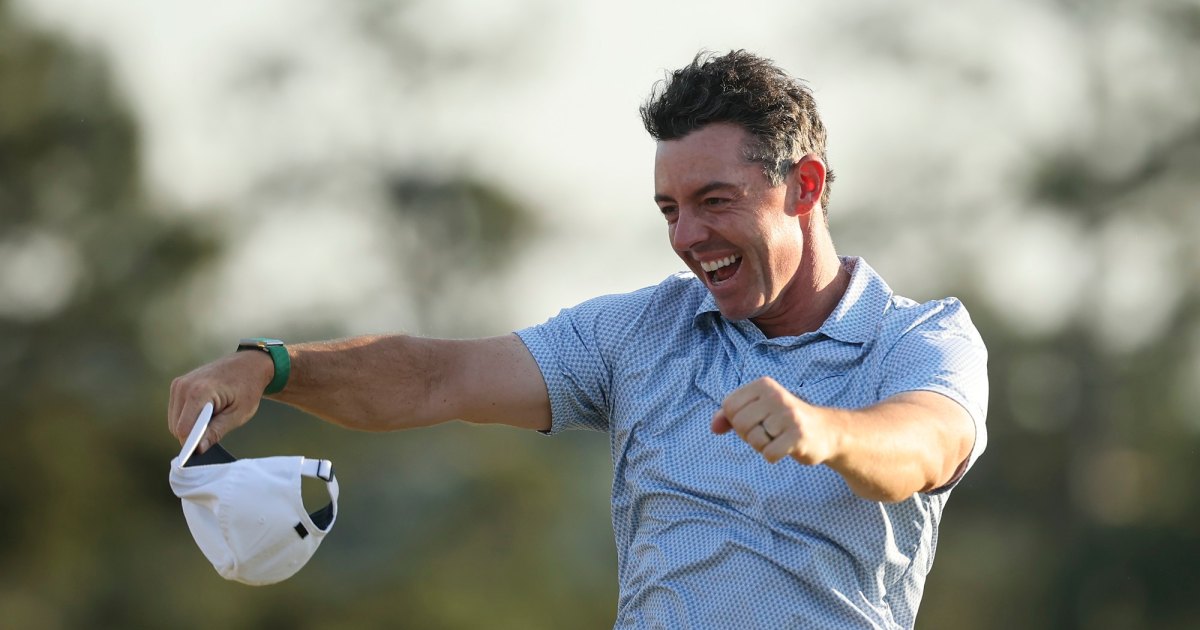
Every Whoop user has been there — just usually not after winning a green jacket. After clinching his second-straight Masters on April 12, Rory McIlroy‘s recovery score cratered from 87 percent to just 7 percent overnight, the result of a long night celebrating with family and friends.
WHOOP recovery data is a daily, color-coded percentage (0-100 percent) indicating your body’s readiness to perform, calculated each morning based on how well you adapted to previous stressors.
McIlroy’s 7 percent recovery is the most relatable data point in an otherwise superhuman week of biometrics: proof that even elite athletes can’t outperform a championship celebration.
Whoop founder and CEO Will Ahmed shared the full breakdown on X, and the crash from green to deep red was the exclamation point on four days of otherwise remarkable numbers.
Rory McIlroy’s Whoop Recovery Scores That Scream Elite
Before the celebration wrecked his Monday morning, McIlroy had been a model of physiological readiness. Ahmed highlighted a resting heart rate of 47–49 bpm throughout tournament week — the kind of baseline that reflects serious cardiovascular conditioning.
More impressive still, McIlroy logged four consecutive days of green recoveries heading into each round: 89 percent, 79 percent, 94 percent and 87 percent from Thursday through Sunday.
Hitting green across a four-day major — while walking Augusta National — suggests his body was primed each morning despite the cumulative strain.
And that strain was significant. Per Sportico’s Kurt Badenhausen, McIlroy logged more than 24,000 steps on Sunday alone and 91,247 steps across the four-day tournament.
Rory McIlroy’s Stressful 18th Hole at the Masters, Broken Down Beat by Beat
The in-round data tells its own story.
McIlroy himself identified the moment of peak pressure during his press conference: “I’d say walking off the 18th tee not knowing where my ball was. I think that was the moment of greatest stress. It could go anywhere. It could be anywhere.”
The Whoop data backs him up. With just a two-shot lead on a par-four and zero margin for error, watch the oscillation:
- 135 bpm — after the errant tee shot that sailed right toward the 10th fairway
- 121 bpm — during his recovery shot, which found the front greenside bunker
- 136 bpm — standing over the ball in the bunker
- 117 bpm — after his third shot settled 12 feet from the hole
- 105 bpm — as he tapped in the winning putt
That drop from 136 to 105 bpm across two shots is a compelling snapshot of McIlroy regulating himself under championship-level pressure. Then the celebration hit, and his heart rate surged to 150 bpm — this time from pure triumph rather than nerves.
Rory McIlroy’s Connection With Whoop Runs Deep
McIlroy isn’t just a user — he’s an investor and global ambassador.
He first invested in Whoop in 2020, when the company was valued at $1.2 billion, per CNBC, alongside Patrick Mahomes, Kevin Durant, Larry Fitzgerald and Justin Thomas.
“I’ve always loved Whoop the product, but I learned that Whoop the business was just as good. I’m proud to be investing again in this round of financing and very excited about the company’s prospects,” McIlroy said at the time.
On March 31, Whoop announced it had raised $575 million more in Series G funding, pushing its valuation to $10.1 billion. McIlroy was again among the investors, joined by Cristiano Ronaldo, LeBron James, Reggie Miller, Niall Horan, and Shane Lowry.
For anyone who tracks their own biometrics daily, this is the kind of real-world, high-stakes data that makes wearable tech feel genuinely powerful — right down to the morning-after recovery hit.
Read the full article here