


In the last message Lyudmyla Dubnytska received from her husband, he told her he was likely about to be captured by Russian forces. Two days later, she recognised his body in a video on social media of a group of killed Ukrainian troops.
ADVERTISEMENT

ADVERTISEMENT
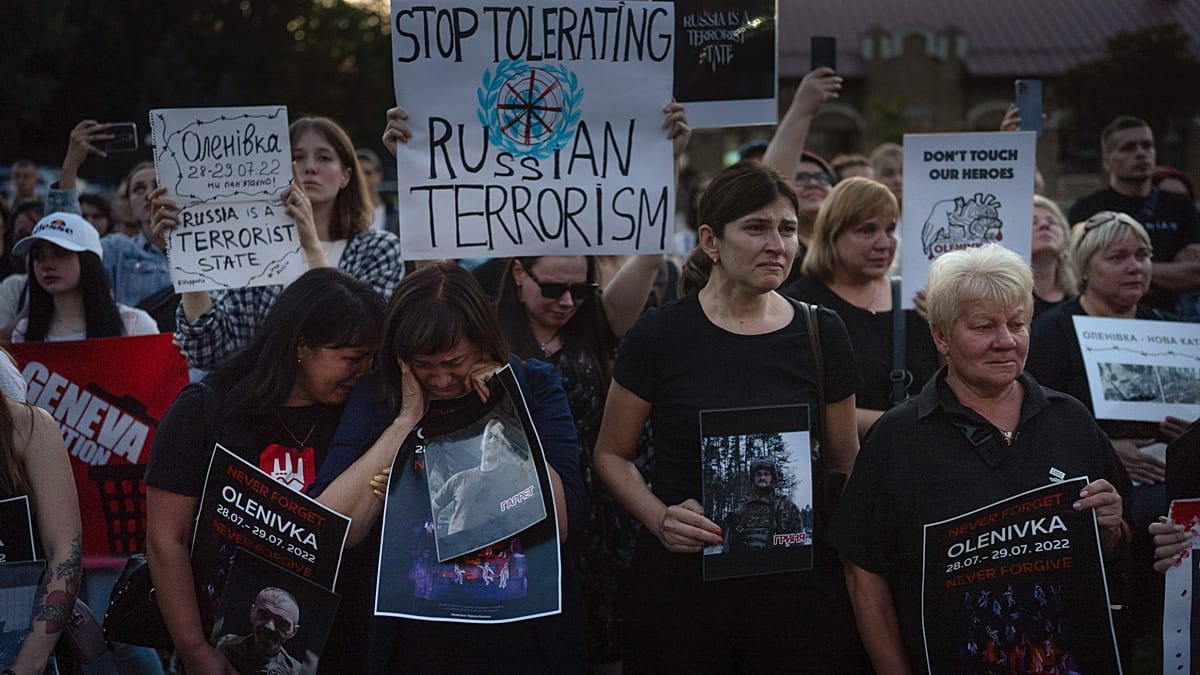
Her partner, Andriy Dubnytsky, is among hundreds of prisoners of war that Kyiv says Russia’s army has executed since it launched its full-scale invasion in 2022.
The exact number is unknown, varying according to different Ukrainian and international sources, but Kyiv alleges the executions reveal a deliberate policy by Moscow.
Dubnytsky was 25 when he was killed in February 2024 as Ukrainian troops retreated from Avdiivka, an epicentre of fighting in eastern Ukraine, captured by Russia.
Wounded during an attempt to withdraw, the soldier from the 110th brigade stayed at his position with five comrades, four of whom were also injured. Despite the dire situation, they were hoping to be evacuated.
When he called his wife on 15 February, “he was extremely nervous and was crying,” Dubnytska, 27, told the AFP news agency.
To keep their spirits up, the couple vowed to have a son when reunited, a sibling for their young daughter.
Several hours later, he sent her a message saying they would probably be captured. Then, he stopped answering.
A video released by Ukrainian media reveals what likely happened next: fellow fighter Ivan Zhytnyk was video-calling a relative when a Russian soldier ordered him to lay down his arms.
Two days later, Lyudmyla saw a video on Russian social media of five bodies lying in a frozen puddle, stained red by blood.
She recognised the tattoo of a cross on one of the men’s hands: her husband.
‘Marked increase’ in cases
The 110th brigade confirmed that several troops, including Dubnytsky and Zhytnyk, had been killed, accusing Russian forces of violating an agreement to evacuate them.
Ukrainian prosecutors opened an investigation into the “shooting of unarmed Ukrainian prisoners of war.”
The incident is not isolated.
Several Ukrainian officials told AFP that Russian troops increased the rate of “executions” starting in 2023.
“This stems from a Russian policy that has effectively encouraged and enabled such crimes, with commanders then issuing orders to that effect,” Andriy Atamantchuk, an official with the Ukrainian Prosecutor General’s Office overseeing the issue of POW executions, said.
The accusations have been rejected by Moscow.
A UN report from last month cited 129 verified executions of Ukrainian prisoners of war, with the organisation sounding the alarm last year over a “marked increase” in cases.
To date, Kyiv has opened 116 investigations into the killings of 306 Ukrainian servicemen since 2022, Atamantchuk said.
He stressed the total is likely to be far higher.
A Ukrainian intelligence official told AFP they have tracked “more than 900 military personnel” killed in “more than 340” incidents since 2022.
Speaking on condition of anonymity, they added this might represent “between 25 and 40 percent” of such cases.
The sources said a difference in methodology accounts for the variance in numbers.
The prosecutor’s office said it relies on “documented and proven facts,” while intelligence services receive “information more quickly” from frontline units and other sources.
Complex investigations
Moscow has systematically rejected accusations of war crimes and in turn accuses Kyiv of committing them.
Under the Geneva Conventions, soldiers are considered POWs and afforded such protections from the moment they issue a clear surrender.
According to Ukrainian intelligence, the Russian Wagner paramilitary group, dismantled after its 2023 rebellion, played a role in “setting the tone” for executions with its ranks of ex-prisoners, many convicted of violent crimes.
Ukraine says most often the victims are shot dead.
In 2023, a viral social media video showed a Russian soldier shooting a Ukrainian soldier after he shouted “Glory to Ukraine.”
Ukrainian investigators have also alleged cases of extremely brutal murders, including beheadings, images of which have circulated on Russian social media.
So far, only five Russian soldiers have been convicted in Ukraine, including two in absentia, prosecutor Atamantchuk told AFP.
The complexity of the investigations, due to a lack of access to combat zones, complicates judicial proceedings.
He has not lost hope to some day “do justice” to the families, if only by giving them “the names of those who killed their loved ones.”
For Dubnytska, learning the identity of her husband’s killer would be “senseless,” she said.
“I don’t know how that would give me any relief, even if I knew one day who did it.”
Russian authorities did not reply to an AFP request to comment on the allegations.
Read the full article here