




Published on
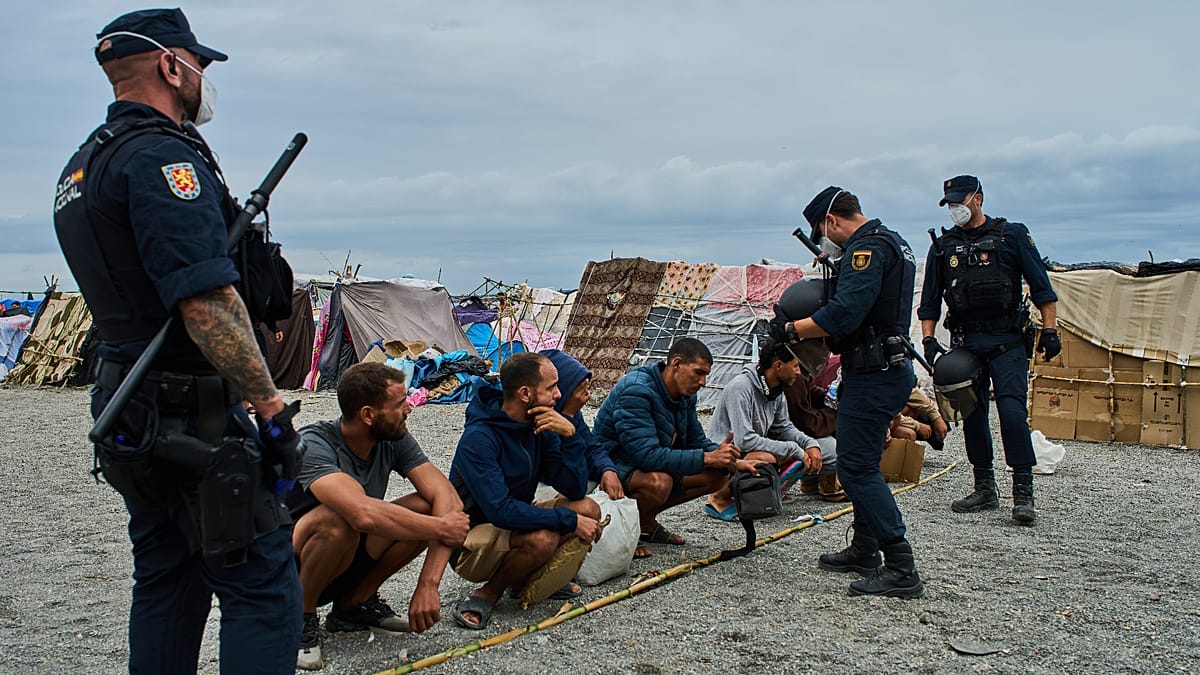
Riot police from Spain’s Police Intervention Unit (UIP), brought in from Seville, Granada, Malaga and other parts of the country, launched Operation Trampolín on Sunday to clear the tents from the settlement that has seen the worst insecurity and tension of the crisis.
ADVERTISEMENT

ADVERTISEMENT
Officers from the Prevention and Reaction Unit (UPR) and intelligence units, both from Ceuta and elsewhere, are also taking part.
Police justified the operation by pointing to conditions at the site. The waters off Trampolín are contaminated, they say, arguing safety cannot be guaranteed, and there is a clear health risk, alongside a rise in violent incidents.
To prevent trouble, officers sealed off all access points, blocking both escapes into the hills and clashes.
Extra vehicles were also deployed, shipped from mainland Spain this week and never before seen in Ceuta, along with a drone monitoring the operation from the air. According to ‘El Faro de Ceuta’, two BMR armoured vehicles and a Vamtac S3 off-road vehicle backed them up, reinforcing security in the city.
Local police announced road closures from around 7.30 a.m. on the roads between Benítez and Benzú. A National Police van was the first to arrive, shortly after half past seven, and the deployment began just before eight.
Just beforehand, there was music, street vendors and people only just waking up in the camp. Some migrants, already nervous, opted to run for the hills. It began to rain at around 8.30.
How the relocation is being carried out
Officers went from tent to tent and shack to shack informing occupants that they had to leave, while taking the tents down. An interpreter explained in Arabic where they would be moved to. Women and children are included in this first phase, although most of those affected are men.
The migrants are being taken by bus to the Tarajal CATE reception centre, where triage and identification are carried out. The first bus left shortly before 9.00, according to ‘Radio Televisión Ceuta’.
It is expected that some may decide to return to their home countries, as several of those moved from Benítez did earlier this week. For now, reception facilities are available at Loma Colmenar, with room for more than 1,000 people, and at the port.
This is the third such operation in a matter of weeks, following the two carried out in Benítez. According to the Higher Police Headquarters, the settlement is home to more than 3,500 people, and Sunday’s operation is only a first phase.
The shortage of places remains the main obstacle. In mid-September, the port camp, built for 1,700 people, left more than 2,000 outside, who returned to the beaches.
The government has set 15 October as the deadline to complete the eviction, and the King and Queen are due to visit on the 13th.
The crisis began at the end of July, when more than 70,000 people crossed from Morocco, most of whom were sent back within a few hours.
Read the full article here