




Can we eat chocolate and save the planet at the same time? The answer now is yes. A young team from southern Germany has developed sustainable “chocolate” made from fermented and roasted sunflower seeds, without using a single cocoa bean.
ADVERTISEMENT


ADVERTISEMENT
This means making the chocolate alternative involves supply chains that are regional instead of global, transportation is therefore shorter and the environmental footprint is much smaller than when making conventional chocolate. The company, Planet A Foods, thereby addresses one of the most pressing challenges in the food industry: the declining availability of cocoa and the ecological costs of conventional chocolate production.
Sara Marquart and her brother Maximilian have won a host of business awards. ChoViva, the chocolate alternative invented by them, is considered a game changing sweet. It could make the chocolate industry independent of global and often fragile cocoa bean supply chains.
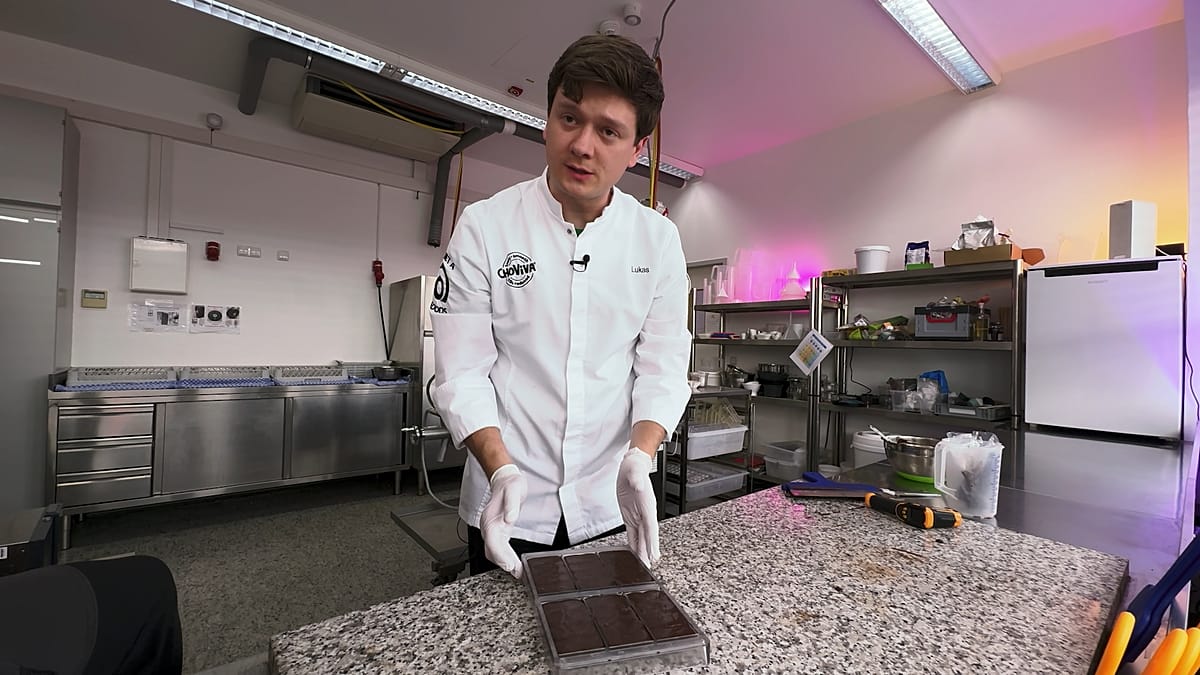
The Munich-based start-up they founded is revolutionising the confectionery industry. In an unassuming industrial estate, chief technology officer Sara is developing one patent after another. Today, she is quite busy, testing a new recipe for the chocolate alternative ChoViva, together with product developer and head chef Lukas Göldner.
But does this chocolate substitute really taste like chocolate? As a reporter, I naturally have to check this out for myself – so I’m doing a blind taste test. To be perfectly honest: there really is no difference in taste between my favourite milk chocolate (made from cocoa beans) and the ChoViva chocolate bar; without the packaging, I couldn’t tell which is ‘real’ chocolate and which is ChoViva.
‘How is that possible?’ I ask Sara and Lukas. Sara goes into detail: “Why does it taste like chocolate? I think we need to delve into the tricks of the trade in research to understand where that chocolate flavour actually comes from. And the fact is that 80% of the aromas and flavour compounds in cocoa come from the processing. So not from the cocoa bean itself, but from fermentation, roasting and conching – that’s the gentle, lengthy processing – milk, sugar and cocoa all come together, well, 80 % of the aromas come from these three processing steps and not from the cocoa bean; if you apply this analogy to other ingredients, then you don’t actually need the cocoa bean at all.”
Product developer Lukas shows me the lab and how it works: “We now have our ingredients for ChoViva here: first, our concentrate, which comes from Pilsen, where our factory is located in the Czech Republic. That consists mainly of sunflower seeds, as well as sugar and the vegetable oil we’ll be using.”
All ingredients are ground and rolled a few times. Then Lukas puts the mix into a slow-moving special stirring machine: “Right, so now we’re going to put it into the conche (mixer) to liquefy it, so that we end up with a lovely, smooth, liquid ChoViva.”
To develop the best chocolate taste possible, the liquid ChoViva has to be at exactly the right temperature. “We temper the mixture to ensure the fat settles into the correct structure”, Lukas explains while working with the liquid. “This means the crystals form a solid structure, and once it has cooled in the fridge, you end up with a product that has a lovely sheen and a crisp texture.”
Lukas fills in a few tablet forms. “Now I’ll just knock the air bubbles out,” he says before putting the tablets into the lab fridge.
The young start-up was founded in 2021. Planet A Foods employs researchers and food industry professionals from 18 countries, including France, Italy, Switzerland, Uruguay, Taiwan, Mexico … the list goes on – and the working language in the open-plan office is predominantly English.
We pop round to see Lukas in the lab again: “Right, we’ve just taken our ChoViva out of the fridge; the crystals have set, so now we can break off a piece and see what it tastes like”, Göldner says, while walking over from the fridge to his testing table.
“A perfect snap”, Göldner smiles. “And now, of course, the most important thing: give it a try.” Head chef and food researcher Göldner takes a bite: “Lovely and melt-in-the-mouth, with a firm bite and a wonderful flavour.”
But why are Planet A Foods using sunflower seeds instead of cocoa beans? Let’s have a coffee break interview with the chief technology officer of Planet A Foods and start-up co-founder, Sara Marquard.
Euronews:
“How did it all start?”
Sara Marquart:
“There’s a scenario in which, by around 2050, 50% of the cocoa supply will be lost, and that was our initial concern. You have to understand that cocoa comes mostly from two countries, Ghana and the Ivory Coast; 80% of the cocoa consumed worldwide comes from these two countries. To do this, rainforest is cleared and cocoa is planted. And these are regions that are extremely fragile and severely affected by climate change. That means it rains at the wrong time, and it’s dry at the wrong time. As a result, cocoa cultivation is at risk. Forecasts suggest that climate change, increased pest infestations and monoculture farming are threatening growing conditions, and it is highly likely that cocoa production will decline.”
Euronews:
“How did the industry react when you launched your chocolate alternative?”
Sara Marquart:
“When we first started out, the industry kind of laughed at us, saying: ‘What sort of clowns are you? Chocolate without cocoa beans – what a load of rubbish’… But then the cocoa crisis in 2023, 2024 and 2025 proved that we’re no clowns. I don’t think anyone’s laughing at us anymore.”
Euronews:
“Was that always your childhood dream – that you used to think, ‘When I grow up, I’m going to be the queen of a chocolate empire’?”
Sara Marquart:
“Our grandparents – well, some of them worked in the food industry, while others ran a farm – so food has always been important to me. I actually wanted to become a chef. But then I studied food technology. And I once wrote a PhD thesis on the formation of aromas and flavours in roasted coffee. The raw material itself is really just like a canvas, but the processing is the paint on the canvas, if you think of it as a kind of painting. That was when I first realised: processing is absolutely key to making food taste really good.”
Euronews:
“What is the impact of your work?”
Sara Marquart:
“Our product reduces CO2 emissions by 70 to 80%, and that’s what drives us. Environmental issues are the driving force behind the company.”
Let’s add a few facts and figures: ChoViva has a 73,6% lower carbon footprint compared to cocoa. ChoViva’s milk recipe, for example, has a climate footprint of 2.8 kg CO₂e/kg. The comparative value for chocolate is 10.6 kg CO₂e/kg.
Planet A Foods stresses: “If everyone in Germany were to consume ChoViva instead of chocolate (currently an average of 9.2 kg per person per year), up to 72 kg of CO₂ per person per year could be saved. This would result in a reduction of approximately 6.02 billion kg of CO₂ for Germany alone.”
In just a few years, Planet A Foods has developed close partnerships with both medium and huge chocolate producers around Europe, including famous brands in Switzerland and Belgium. Planet A Foods produces the raw material, that’s ChoViva, and delivers it to chocolate plants all across the continent where it finds its way into ChoViva bars and biscuits.
My reporting trip takes me further on to France, to the Alsace region, where I meet Anne-Catherine Wagner-Abtey, the owner and managing director of the well-known Abtey Chocolaterie. This medium-sized family-run business was the first French company to switch part of its production to the chocolate alternative ChoViva. This led to economic growth and created jobs. The annual turnover rose to €21 million. Abtey Chocolaterie is a stunning success story: Today, the company exports to 47 countries around the world.
Anne-Catherine Wagner-Abtey shows me around the busy production facility. “We are a family-run business. Traditionally, we’ve only worked during the Christmas and Easter periods; these are our two busiest times of the year. Now, thanks to ChoViva, we’ve gained access to new markets that allow us to work consistently throughout the year.”
Euronews:
“How did it all start?”
Anne-Catherine Wagner-Abtey:
“We had to adapt this new ingredient, ChoViva, to our technical production process. It was a bit of a risky, bold move, because up until then our machines had only used chocolate, and I was absolutely not keen on investing in new machinery as that would have been too risky for us. So we worked for nine months with Planet A Foods to adapt the ChoViva rheology (fluidity/flow) to our machines.”
Euronews:
“You’ve brought a photo album with you; if I’ve understood correctly, these are photos of your grandparents?”
Anne-Catherine Wagner-Abtey:
“This is the story of our chocolate factory, spanning 80 years. You can see my grandfather, who qualified as a master chocolatier, the first set-up in the cellar of his house, the first machines – and then that fantastic partnership with my grandmother. And today I am very proud of this gift they have left me, and I try to look after it.”
Euronews:
“You’ve been through a serious chocolate crisis – or rather, a serious cocoa crisis. How did you get out of it? “
Anne-Catherine Wagner-Abtey:
“The cocoa crisis that began in January 2024 was particularly worrying for us, because we’d heard about a cocoa shortage – and if I run out of cocoa, what am I supposed to do? What do I put in my machines?
And in January 2024, we were lucky enough to meet the start-up Planet A Foods at a trade fair, and we thought that perhaps here we had a solution to the cocoa crisis, a solution that also aligned with our values.
We’re going to keep making traditional chocolate, too. My grandfather’s recipe. But it’s important for us to come up with alternatives – alternatives that make sense, that are delicious and indulgent, but also eco-friendly and good for the planet.”
Wagner-Abtey’s daughter Elena is already helping out in the business. When the kids take over one day, the long-established French chocolate company will be run by the family’s fourth generation.
But let’s finish this story back in Germany, back in Bavaria. Planet A Foods manager Sara Marquart goes shopping. In a big supermarket she buys kilos of crunchy biscuits to check that the quality is up to scratch, even on the shelf.
Planet A Foods produces 10,000 tonnes of ChoViva a year. And growth rates are impressive. Confectionery manufacturers across Europe, including well-known multinationals, are absolutely crazy about the chocolate substitute.
“In recent years, the price of cocoa has actually been two, three or four times as high,” Sara says. “I think we’ve all felt the pinch. An alternative like ChoViva is cheaper.”
What does the future hold? Where are we headed? “We want to make chocolate future-proof by producing it regionally and locally in Europe using ingredients sourced from Europe”, Sara says. “That is why our vision and mission is to become an integral part of the chocolate world of tomorrow and to ensure that our children and our children’s children can enjoy chocolate.” As Sara drives her electric car home, her thoughts turn to her newborn child: “I’ve got a little baby now, and I want my daughter to have a chocolate Easter bunny one day too.”
Read the full article here