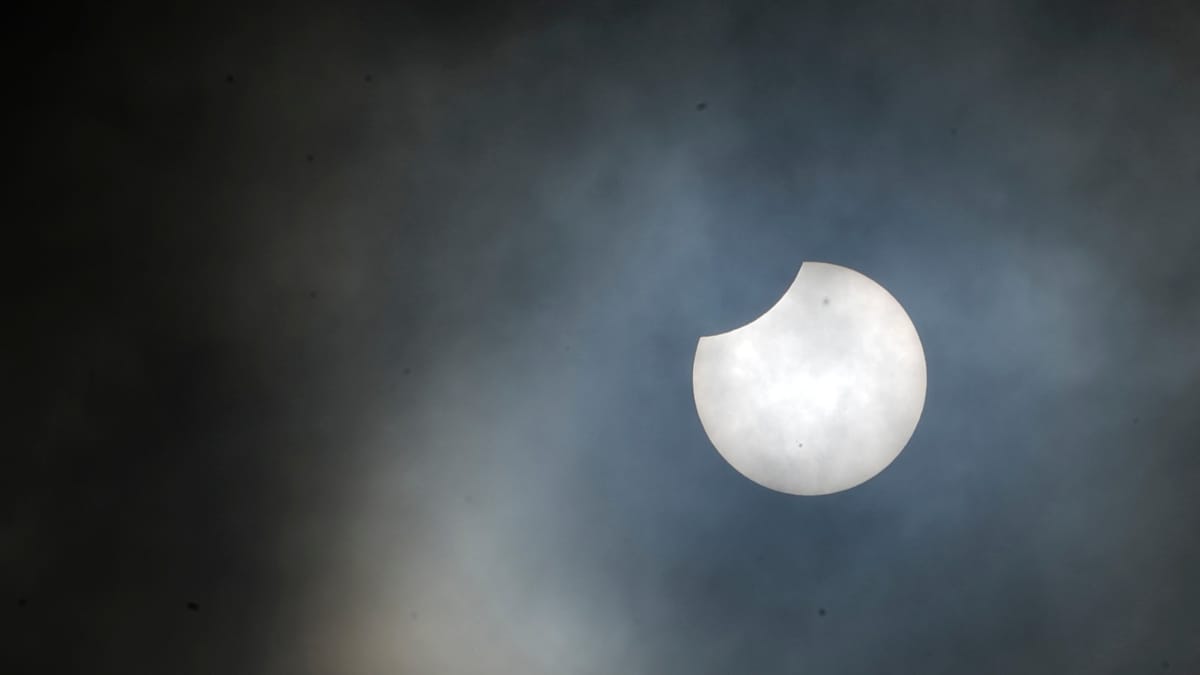




A spectacular solar eclipse wowed those lucky enough to be on Easter Island in the Pacific Ocean in October 2024, but now a different part of the world is preparing to witness the astronomical phenomenon.
ADVERTISEMENT


ADVERTISEMENT
This Wednesday (12 August 2026), the moon will pass perfectly between the sun and the Earth, casting its shadow across a narrow swathe of the planet with many parts of Greenland, Iceland, and northern Spain, experiencing the total eclipse while millions of Europeans across western Europe will witness a visible partial eclipse.
It will take 1.5 hours for the umbra, or moon’s sun-blocking shadow, to race along the 8,260-kilometre course, most of it over an empty Atlantic.
But starting near the North Pole around Siberia in Russia, before tracking south, totality is expected to last up to 2 minutes and 18 seconds. Daytime darkness will descend across the Iberian Peninsula, plus slivers of Greenland and Iceland.
This rare sight is expected to attract crowds who want to experience darkness during the day, the sudden drop in temperature that comes with an eclipse, and animals and birds going quiet as they confuse the moment with nighttime.
In London, the historic Royal Observatory Greenwich will host a watch party from its terraces, live streaming the event—weather permitting—as the sun is obscured over the city’s skyline.
Spain to experience total eclipse—the first time in over a century
In the UK, more than 90% of the sun will be covered by the moon for most parts.
“From here in the UK, we’re going to actually be very fortunate. We are seeing a partial eclipse, but it is a very strong partial, between 90 and 95%, depending on where you are in the UK,” explains Jake Foster, an astronomer at the Royal Observatory Greenwich.
“It’s going to be happening around sunset. It is the golden hour eclipse, so it’s going to be low on the western horizon. If you want to see the full eclipse, you need to get into the path of totality. And to get into the path totality, you’re going to need to go to places like Greenland, Iceland, and northern Spain.
Those are the places where the moon’s shadow will be at its darkest, and you’ll get that absolute 100% coverage of the moon in front of the sun.”
A new moon passing between the sun and Earth is known as an eclipse. Only on the rare occasions when the moon passes exactly between our planet and the sun may that occur. Although the sun is 400 times larger than the moon, they appear to be about the same size in the sky because of their 400-fold distance from one another.
It’s this quirk of the solar system that allows the moon to almost completely block the light of the sun.
Where the moon casts a total shadow is known as the umbra. Where it only partially blocks the sun and gives viewers on Earth a partial eclipse, it’s known as the penumbra.
It can be a long wait to see such an event: Spain’s last full solar eclipse—not counting the Canary Islands—occurred two days before the Titanic’s sinking in 1912.
Maximum totality will occur off Iceland’s west coast. And by the time it reaches a small patch of Portugal and then Spain with its massive crowds, totality will have dwindled to a minute or so. The spectacle will end in the Mediterranean.
“Well, in order to see a total solar eclipse from the very same location more than once, you could be waiting over 200 years for that to happen. Partial eclipses can be slightly more common. But again, if we’re talking about just from one particular country or one particular region of a country, you might get lucky; you might have a few partial eclipses in a decade. However, they can be very rare depending on where you are,” says Foster.
Solar eclipse glasses to see the eclipse
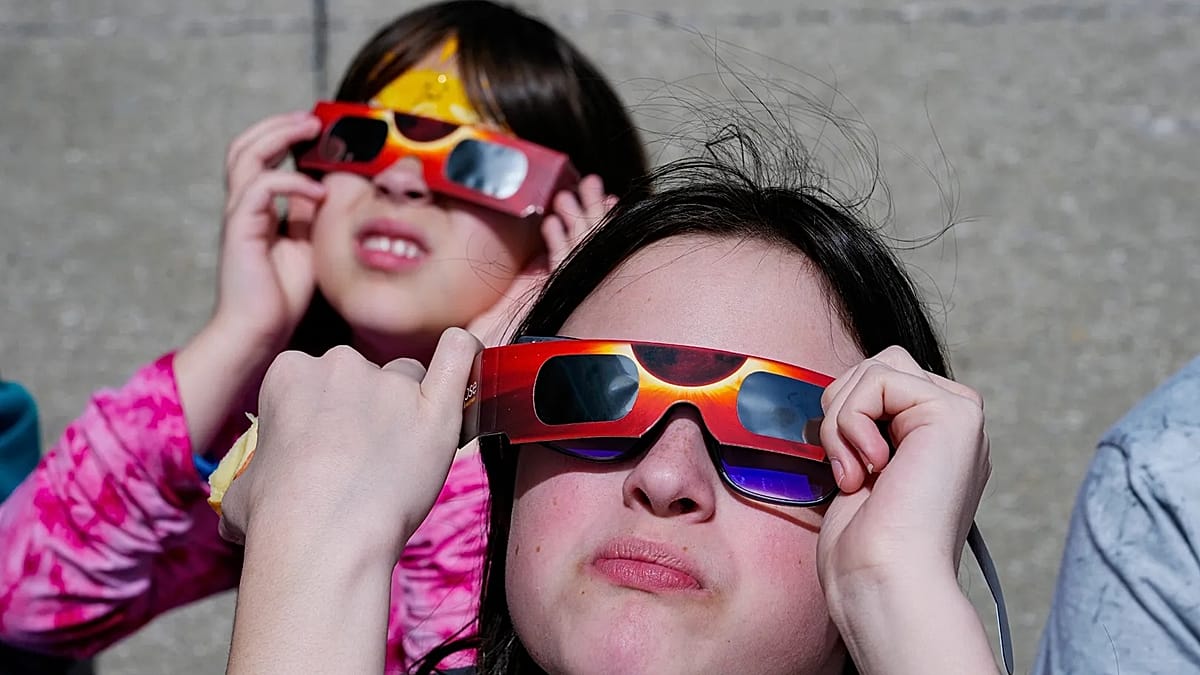
To watch the phenomenon, viewers need a simple but essential piece of kit: solar eclipse glasses.
Without these, staring directly at the sun—even if just a slither of light remains—could damage eyesight.
“The safest way to view the eclipse directly is with a pair of solar eclipse glasses. They have special lenses in them that block out 99.9999% of the sun’s light, only then making it safe to view. You’ve got to make sure that they are ISO certified so that they’ve been through the rigorous safety standards testing. But as long as you know that they’re safe to use, you can directly look up towards the sun when viewing the eclipse,” says Foster.
While these events are very predictable, even hundreds of years into the future, they are still a source of excitement for the scientific community. But also millions of people across the world.
Across Europe, astronomy shops are seeing a last-minute rush for certified viewing equipment. At one specialist store in Paris, the French capital, customers queued for more than two hours to get their hands on eclipse glasses and binoculars.
“Two hours! Two hours for a pair of sunglasses,” 27-year-old Simon Noé who works in video game research, said Monday. “But for me, the eclipse is kind of a big deal. I remember when I was a child, I thought, What, there won’t be another eclipse before 2026? 2026 seemed so far away. So this is a bit about making my inner child happy,” he added.
Two of ESA’s space telescopes will observe the eclipsed sun and its corona, or outer atmosphere.
Proba-3, the space agency’s artificial eclipse-making satellite duo, will be positioned poorly but will try to sneak in some before-and-after shots.
“Solar eclipses are still incredibly exciting, even if you’ve seen a few of them. It really is a bucket list event, and there’s really no limit to the amount of times you can see a bucket list event,” says Foster.
Read the full article here