




Published on
The Visegrád Four (V4) was set up in 1991 to guide these post-communist neighbours into the West. But beyond geography, Poland, Czechia, Slovakia, and Hungary are bound by the same massive Central European automotive and manufacturing supply chains and a shared goal to protect billions in EU cohesion funding.
ADVERTISEMENT


ADVERTISEMENT
Their most significant political impact came in 2015, when their coordinated resistance forced Brussels to abandon mandatory migration quotas.
But this is no longer the poor relation of Western Europe. Central Europe enters this new chapter with economic strength.
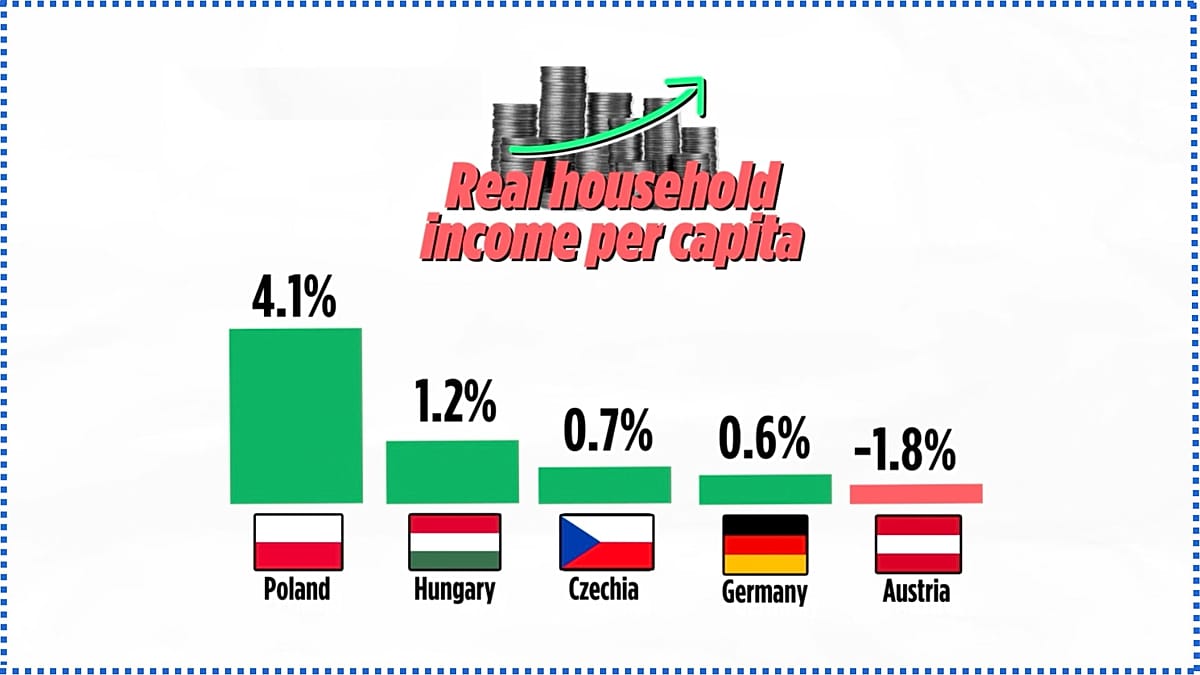
Look at the data: last year, Poland led the continent with a booming 4.1% real household income growth, while Germany lagged at 0.6% and Austria’s household income even declined. And this wealth flip gives the region confidence.
Magyar is even pitching a bold plan to merge the V4 with Austria, with reports suggesting Vienna is receptive to a Benelux-style alliance.
However, to be more realistic: can this bloc actually deliver anything tangible?
Critics point out that the V4 has historically struggled to look beyond its own internal divisions. In the past, cooperation was derailed by fears of a revived Austrian hegemony, and today, old bilateral disputes between neighbours like Slovakia and Hungary still cause friction.
Moreover, acting as “one voice” in Brussels won’t be seamless. And while they aim to cooperate on regional energy and transport infrastructure, geopolitical fault lines remain. Hungary, Czechia, and Slovakia—unlike Poland— are opting out of the EU’s ninety-billion-euro loan package for Ukraine.
Will potential divisions stop this bloc from making a real impact? Only time will tell. However, with Magyar finally in the fold, it turns out the three musketeers were just waiting for their fourth.
Watch the Euronews video in the player above for the full story.
Read the full article here